
- Shows all characteristics known from the Siamese pointed cats, but all four feet are white (gloves).
About the Birman
Origin: France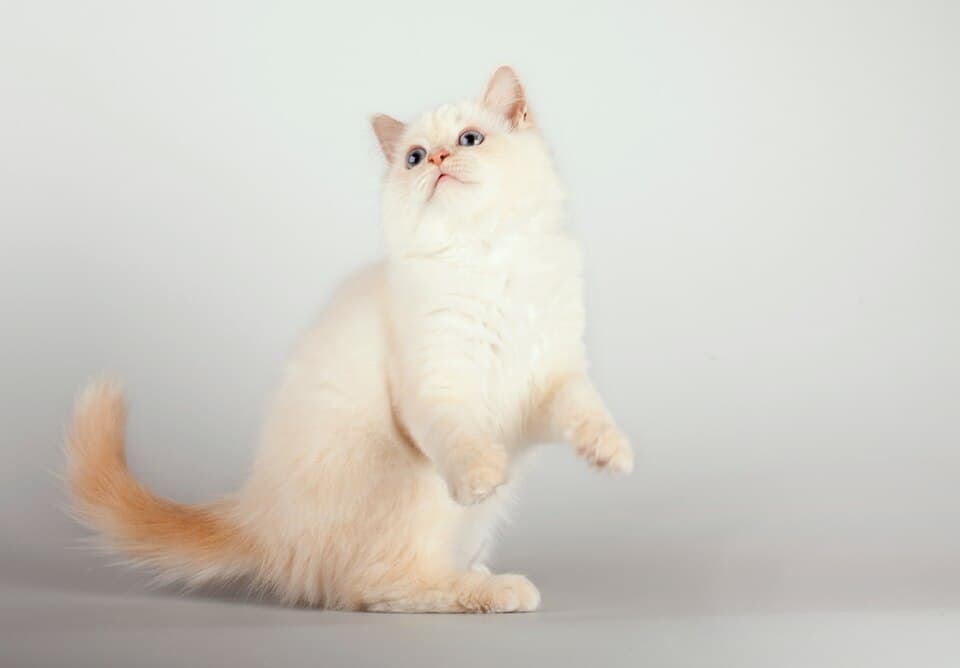
- Typical life span
- 12-16 years
- Size
- Medium — from its typical weight
- Weight
- 4.5-6.8 kg
- Height
- 25-30 cm
- Registry status
- Recognised by TICA
- Breed group
- Long-haired
- Origin
- France
- Known hereditary risks
- 2 documented conditions, with the test for each
About
What is a Birman?
Medium to large, colorpointed cat with long silky coat, white gloved paws, and striking blue eyes. Known for its gentle, docile temperament.
Birman history and origins
Legend says they were temple cats in Burma (Myanmar). The breed as known today was developed in France in the early 1900s. Nearly extinct after WWII but carefully rebuilt. Known as the Sacred Cat of Burma.
Birman appearance and size
Typically 4.5-6.8 kg and 25-30 cm at the shoulder — published as one range rather than separately for males and females.
Birman temperament and personality
Generally described as affectionate, active, gentle, social, quiet and loyal.
That is the breed in general, not a promise about one animal. Ask the breeder what their own line is like, and meet the parents before you decide.
Breed reference from The Cat API.
Characteristics
- Size
- Medium
- Exercise needs
- —
- Easy to train
- —
- Amount of shedding
- 3 of 5
- Grooming needs
- 4 of 5
- Good with children
- —
- Cost to keep
- —
- Tolerates being alone
- —
- Intelligence
- —
- Health of breed
- 2 conditions documented
Pros & cons
Pros & cons for the Birman
What you get with the Birman
- Commonly described as: “Affectionate, Active, Gentle, Social”
- Longer-lived than a non-pedigree cat — median 15.54 years across 38 recorded deaths, against 13.01
What you are taking on
- 2 serious inherited conditions are documented, mainly in brain & nerves and skin & coat. The health guide tab has the test to ask for on each.
- High grooming needs — the standard’s own description is “Long to semi-long, according to the actual parts of the body: short on the face,…”
Drawn from sources rather than written as an opinion — cited health research, the registry’s own standard, and peer-reviewed longevity. The Cat API; Teng et al. 2024, median age at death; Wisdom Panel — Hypotrichosis (cat health conditions); FIFe breed standard. One breeder’s animals can differ from any of it, and an empty column means we hold nothing for that side rather than that there is nothing to say.
Characteristics
FIFe standard · Birman
Coat and colour
As the FIFe standard sets it out. Every line below is the standard’s own wording.
Coat
Long to semi-long, according to the actual parts of the body: short on the face, gradually growing longer on the cheeks to a full frill, long on the back and the flanks.
Silky texture.
Little undercoat.
Colour
- Preferred
- Permissible
- Undesirable
- Disqualifying
Preferred, permissible, undesirable and disqualifying are FIFe’s own words about the breed. They describe what the standard asks for — not an assessment of any individual dog, and not ours.
Shortened from FIFe standard SBI — each label is the standard’s own wording with the verdict lifted into the tag beside it. Read the full clause at source.
Temperament
AffectionateActiveGentleSocialQuietLoyal
Breed-level information from The Cat API. It describes the Birman in general; any individual animal can differ.
Health guide
Health & screening guide for the Birman
Known hereditary risks for the Birman breed, and the specific documentation to request from any breeder before paying a deposit. A responsible breeder will have these readily available; deflection is a red flag.
2 conditions documentedThis is breed-level literature, not veterinary advice about an individual animal — your vet knows the animal.
Health checklist (PDF)Brain & nerves
Hereditary distal polyneuropathy
Serious
A degenerative nerve disease reported in related Birman kittens, causing progressive unsteadiness and weakness in the hind legs from a young age. No causative gene has been identified, so there is no DNA test; the original report describes it as being of suspected, not confirmed, inherited origin.
What to ask for
No DNA test exists — ask whether the line has any history of unexplained hind-limb weakness or unsteadiness in young kittens
Skin & coat
Congenital hypotrichosis with short life expectancy (FOXN1 deletion)
Serious
An autosomal recessive deletion in the FOXN1 gene that causes kittens to be born with little to no coat and, more importantly, is associated with a much shorter lifespan. A validated DNA test exists and is the only reliable way to identify carriers, since the coat effect is not always obvious to the eye.
What to ask for
FOXN1 deletion DNA test (offered by Wisdom Panel and specialist feline genetics laboratories), on both parents
How long the Birman lives, in the records
Median age at death 15,5 years
Middle half of deaths between 12,6 and 18,1 years, from 38 recorded deaths. 2,6% of them were before age two.
Computed from United Kingdom veterinary records covering 7936 deaths. This is an age at death, not a life expectancy: half the cats of this breed in the records died younger.
Dataset: O'Neill, D. & Teng, K.T. (2024), Figshare, doi:10.6084/m9.figshare.25006802, CC BY 4.0. Teng, K.T., Brodbelt, D.C., Church, D.B. & O'Neill, D.G. (2024) Life tables of annual life expectancy and risk factors for mortality in cats in the United Kingdom. Journal of Feline Medicine and Surgery 26(5).
Gallery
No photographs yet
This is where Birman owners’ own photographs will go, from the pet profiles they keep here. Nobody has added one to a public page yet.
A photograph in a pet profile stays private to its owner. We will not put one here unless they ask us to.
Kittens
No kittens listed right now
That is not the same as none existing. Publishing a litter is part of a breeder's subscription here, so a Birman breeder can have a litter and no listing — ask them directly.
See Birman breeders