
- Shows all characteristics known from the Siamese pointed cats, but all four feet are white (gloves).
About the Birman
Origin: France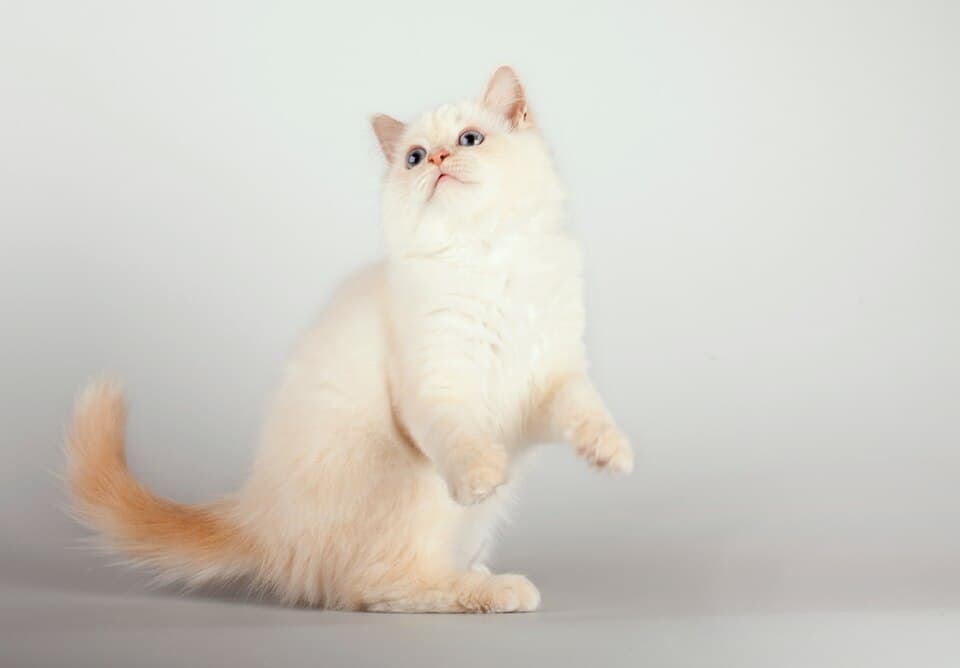
- Typical life span
- 12-16 years
- Size
- Medium — from its typical weight
- Weight
- 4.5-6.8 kg
- Height
- 25-30 cm
- Registry status
- Reconocida por la TICA
- Breed group
- Long-haired
- Origin
- France
- Known hereditary risks
- 2 documented conditions, with the test for each
About
What is a Birman?
Medium to large, colorpointed cat with long silky coat, white gloved paws, and striking blue eyes. Known for its gentle, docile temperament.
Birman history and origins
Legend says they were temple cats in Burma (Myanmar). The breed as known today was developed in France in the early 1900s. Nearly extinct after WWII but carefully rebuilt. Known as the Sacred Cat of Burma.
Birman appearance and size
Typically 4.5-6.8 kg and 25-30 cm at the shoulder — published as one range rather than separately for males and females.
Birman temperament and personality
Generally described as affectionate, active, gentle, social, quiet and loyal.
That is the breed in general, not a promise about one animal. Ask the breeder what their own line is like, and meet the parents before you decide.
Referencia de la raza de The Cat API.
Características
- Tamaño
- Medium
- Necesidad de ejercicio
- —
- Facilidad de adiestramiento
- —
- Caída de pelo
- 3 of 5
- Cuidados del pelo
- 4 of 5
- Convivencia con niños
- —
- Coste de mantenimiento
- —
- Tolera quedarse solo
- —
- Inteligencia
- —
- Salud de la raza
- 2 conditions documented
Pros & cons
Pros y contras de la raza Birman
Lo que obtienes con la raza Birman
- Descrito habitualmente como: «Affectionate, Active, Gentle, Social»
- Vive más que un gato sin raza definida — mediana de 15.54 años en 38 muertes registradas, frente a 13.01
Lo que asumes
- Están documentadas 2 enfermedades hereditarias graves, sobre todo en cerebro y nervios y piel y pelo. La pestaña de la guía de salud tiene la prueba que hay que pedir en cada una.
- Exige muchos cuidados del pelo — la descripción del propio estándar es «Long to semi-long, according to the actual parts of the body: short on the face,…»
Extraído de fuentes y no escrito como opinión — investigación de salud citada, el estándar del propio registro, y estudios de longevidad revisados por pares. The Cat API; Teng et al. 2024, median age at death; Wisdom Panel — Hypotrichosis (cat health conditions); Estándar de la raza, FIFe. Los animales de un criador pueden diferir de todo esto, y una columna vacía significa que no tenemos nada de ese lado, no que no haya nada que decir.
Characteristics
Estándar de la FIFe · Birman
Pelo y color
Tal como lo establece el estándar de la FIFe. Cada línea de abajo está en las palabras del propio estándar.
Coat
Long to semi-long, according to the actual parts of the body: short on the face, gradually growing longer on the cheeks to a full frill, long on the back and the flanks.
Silky texture.
Little undercoat.
Color
- Preferred
- Permissible
- Undesirable
- Disqualifying
«Preferred», «permissible», «undesirable» y «disqualifying» — preferido, admisible, indeseable y descalificante — son las palabras de la propia FIFe sobre la raza, y quedan en inglés porque así constan en el estándar. Describen lo que el estándar pide — no son una valoración de ningún perro concreto, ni nuestra.
Resumido de FIFe standard SBI — cada etiqueta está en las palabras del propio estándar, con el veredicto pasado a la etiqueta de al lado. Lee la cláusula completa en la fuente.
Temperamento
AffectionateActiveGentleSocialQuietLoyal
Información a nivel de raza, de The Cat API. Describe la raza Birman en general; cualquier animal concreto puede ser distinto.
Health guide
Health & screening guide for the Birman
Riesgos hereditarios conocidos en la raza Birman, y la documentación concreta que hay que pedir a cualquier criador antes de pagar una señal. Un criador responsable tiene esta documentación a mano; esquivar la pregunta es mala señal.
2 enfermedades documentadasEsto es literatura a nivel de raza, no asesoramiento veterinario sobre un animal concreto — tu veterinario conoce al animal.
Health checklist (PDF)Brain & nerves
Hereditary distal polyneuropathy
Serious
A degenerative nerve disease reported in related Birman kittens, causing progressive unsteadiness and weakness in the hind legs from a young age. No causative gene has been identified, so there is no DNA test; the original report describes it as being of suspected, not confirmed, inherited origin.
Qué pedir
No DNA test exists — ask whether the line has any history of unexplained hind-limb weakness or unsteadiness in young kittens
Skin & coat
Congenital hypotrichosis with short life expectancy (FOXN1 deletion)
Serious
An autosomal recessive deletion in the FOXN1 gene that causes kittens to be born with little to no coat and, more importantly, is associated with a much shorter lifespan. A validated DNA test exists and is the only reliable way to identify carriers, since the coat effect is not always obvious to the eye.
Qué pedir
FOXN1 deletion DNA test (offered by Wisdom Panel and specialist feline genetics laboratories), on both parents
Cuánto vive la raza Birman, en los registros
Edad mediana al morir de 15,5 años
Mitad central de las muertes entre los 12,6 y los 18,1 años, a partir de 38 muertes registradas. El 2,6% de ellas ocurrió antes de los dos años.
Calculado a partir de registros veterinarios del Reino Unido que cubren 7936 muertes. Esto es una edad al morir y no una esperanza de vida: la mitad de los gatos de esta raza en los registros murió más joven.
Dataset: O'Neill, D. & Teng, K.T. (2024), Figshare, doi:10.6084/m9.figshare.25006802, CC BY 4.0. Teng, K.T., Brodbelt, D.C., Church, D.B. & O'Neill, D.G. (2024) Life tables of annual life expectancy and risk factors for mortality in cats in the United Kingdom. Journal of Feline Medicine and Surgery 26(5).
Gallery
Todavía sin fotografías
Aquí es donde irán las fotografías de los propios dueños de Birman, desde los perfiles de sus animales que mantienen aquí. Nadie ha añadido ninguna a una página pública todavía.
Una fotografía en un perfil de animal queda privada de su dueño. No pondremos ninguna aquí a menos que nos lo pidan.
Kittens
No kittens listed right now
That is not the same as none existing. Publishing a litter is part of a breeder's subscription here, so a Birman breeder can have a litter and no listing — ask them directly.
See Birman breeders