
Skip to content

About the Bengal

Origin: United States
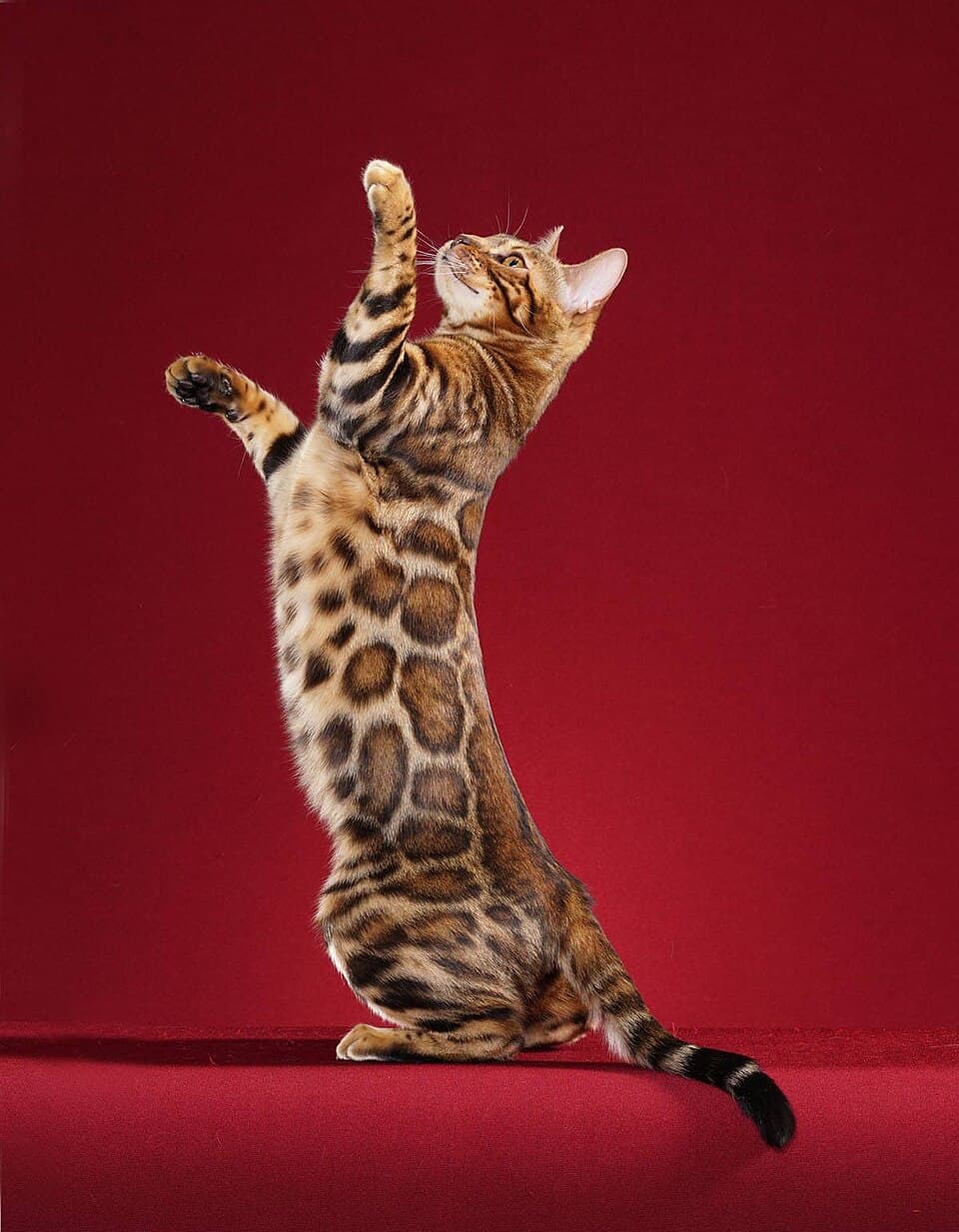
Bengal cat
Photo by Lightburst, CC BY-SA 4.0
View Bengal breedersSee Bengal kittens

21 breeders are on record here.

Typical life span
12-16 years
Size
Large — from its typical weight
Weight
4.5-8.2 kg
Height
33-41 cm
Registry status
Recognised by TICA
Breed group
Short-haired
Origin
United States

About

What is a Bengal?

Medium to large, muscular cat with a distinctive wild appearance featuring spotted or marbled coat patterns. Highly athletic and intelligent with an exotic look.

Bengal history and origins

Developed by crossing domestic cats with the Asian leopard cat starting in the 1960s-70s by Jean Mill. Named after the leopard cat's scientific name (Prionailurus bengalensis). Recognized by TICA in 1983.

Bengal appearance and size

Typically 4.5-8.2 kg and 33-41 cm at the shoulder — published as one range rather than separately for males and females.

Bengal temperament and personality

Generally described as alert, agile, energetic, demanding, intelligent, curious and playful.

That is the breed in general, not a promise about one animal. Ask the breeder what their own line is like, and meet the parents before you decide.

Breed reference from The Cat API.

Characteristics

Size
Large
Exercise needs
Easy to train
Amount of shedding
Grooming needs
2 of 5
Good with children
Cost to keep
Tolerates being alone
Intelligence

Pros & cons

Pros & cons for the Bengal

What you get with the Bengal

  • Low grooming needs, fitting for a busy owner — the coat is “Short. Allowance for slightly longer coat in kittens.”
  • Commonly described as: “Alert, Agile, Energetic, Demanding”

What you are taking on

  • 3 serious inherited conditions are documented, mainly in heart & circulation and eyes. The health guide tab has the test to ask for on each.

Drawn from sources rather than written as an opinion — cited health research, the registry’s own standard, and peer-reviewed longevity. FIFe breed standard; The Cat API; UC Davis VGL — PRA-b (Bengal) test. One breeder’s animals can differ from any of it, and an empty column means we hold nothing for that side rather than that there is nothing to say.

Characteristics

FIFe standard · Bengal

Coat

As the FIFe standard sets it out. Every line below is the standard’s own wording.

Coat

Short.

Allowance for slightly longer coat in kittens.

Texture is thick, luxurious, unusually soft to the touch and preferably showing glitter.

Shortened from FIFe standard BEN — each label is the standard’s own wording with the verdict lifted into the tag beside it. Read the full clause at source.

TICA divisions

TICA lists the Bengal in these divisions. They are the registry's own groupings — usually hair length — not a list of colours: no registry we hold publishes one. Ask a breeder what colours their line produces.

  • Longhair

Temperament

AlertAgileEnergeticDemandingIntelligentCuriousPlayful

Breed-level information from The Cat API. It describes the Bengal in general; any individual animal can differ.

Health guide

Health & screening guide for the Bengal

Known hereditary risks for the Bengal breed, and the specific documentation to request from any breeder before paying a deposit. A responsible breeder will have these readily available; deflection is a red flag.

3 conditions documented

Health checklist (PDF)

Heart & circulation

Hypertrophic cardiomyopathy (HCM)

Serious

A thickened heart muscle disease reported in Bengals in breed-specific echocardiography research; a US veterinary school has run a dedicated Bengal HCM study programme. No breed-validated DNA marker exists for Bengal, unlike Maine Coon or Ragdoll, so echocardiography is the only way to screen for it.

What to ask for

No breed-validated DNA test exists — ask for a recent echocardiogram, read by a cardiologist, on both parents

2 sources

Eyes

Progressive retinal atrophy (PRA-b)

Serious

A Bengal-specific, autosomal recessive form of inherited blindness caused by a mutation distinct from the Abyssinian's, destroying the light-sensing cells of the retina. UC Davis offers a dedicated DNA test for this Bengal-only mutation.

What to ask for

UC Davis VGL Bengal-specific PRA (PRA-b) DNA test result, on both parents

1 source

Blood

Erythrocyte pyruvate kinase (PK) deficiency

Serious

The same inherited haemolytic anaemia documented in Abyssinians is also listed by UC Davis as appropriate for testing in Bengals, reflecting the breed's own foundation ancestry.

What to ask for

UC Davis VGL PK deficiency DNA test result, on both parents

1 source

How long the Bengal lives, in the records

Median age at death 8.4 years

Middle half of deaths between 2.1 and 14.1 years, from 73 recorded deaths. 23.3% of them were before age two.

Read this with care. Well above the 7.5% seen in non-pedigree cats, which pulls the median down. That can mean higher mortality in young cats, or simply that the breed has become popular recently so most of its cats are still young — these records cannot tell the two apart.

Computed from United Kingdom veterinary records covering 7,936 deaths. This is an age at death, not a life expectancy: half the cats of this breed in the records died younger.

Dataset: O'Neill, D. & Teng, K.T. (2024), Figshare, doi:10.6084/m9.figshare.25006802, CC BY 4.0. Teng, K.T., Brodbelt, D.C., Church, D.B. & O'Neill, D.G. (2024) Life tables of annual life expectancy and risk factors for mortality in cats in the United Kingdom. Journal of Feline Medicine and Surgery 26(5).

Kittens

No kittens listed right now

That is not the same as none existing. Publishing a litter is part of a breeder's subscription here, so a Bengal breeder can have a litter and no listing — ask them directly.

See Bengal breeders
Sections