- Permissible: All colour varieties and patterns, including those with white
- Permissible: Any amount of white
About the Peterbald
Origin: Russia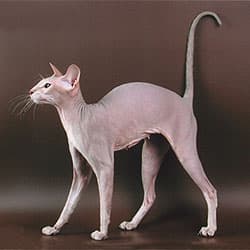
View Peterbald breedersSee Peterbald kittens
Ainda não há nenhum criador em registo aqui. O clube português membro da FIFe não lista esta raça no seu diretório de criadores, por isso uma ausência aqui não diz nada sobre se alguém a cria em Portugal.
- Typical life span
- 10-15 years
- Size
- Medium — from its typical weight
- Weight
- 3.2-6.4 kg
- Height
- 25-36 cm
- Registry status
- Reconhecida pela TICA
- Breed group
- Hairless
- Origin
- Russia
- Known hereditary risks
- 2 documented conditions, with the test for each
About
What is a Peterbald?
Medium-sized, elegant hairless or partially haired cat with long narrow head and large ears. Russian breed related to Oriental type.
Peterbald history and origins
Developed in St. Petersburg, Russia in 1994 by crossing a Don Sphynx with an Oriental Shorthair. Combines Oriental elegance with hairlessness. Can range from completely bald to short coat.
Peterbald appearance and size
Typically 3.2-6.4 kg and 25-36 cm at the shoulder — published as one range rather than separately for males and females.
Peterbald temperament and personality
Generally described as highly intelligent, affectionate, playful, active, athletic and social.
That is the breed in general, not a promise about one animal. Ask the breeder what their own line is like, and meet the parents before you decide.
Referência da raça de The Cat API.
Características
- Tamanho
- Medium
- Necessidade de exercício
- —
- Facilidade de treino
- —
- Queda de pelo
- 1 of 5
- Cuidados com o pelo
- 1 of 5
- Convivência com crianças
- —
- Custo de manutenção
- —
- Tolera ficar sozinho
- —
- Inteligência
- —
- Saúde da raça
- 2 conditions documented
Pros & cons
Prós e contras da raça Peterbald
O que ganha com a raça Peterbald
- Exige poucos cuidados com o pelo, adequado a quem tem pouco tempo — o pelo é «Appears hairless. Short, soft, fine hair on the muzzle, at the base of the ears, legs and…»
- Descrito habitualmente como: «Highly intelligent, Affectionate, Playful, Active»
O que tem de assumir
- Está documentada uma doença hereditária grave, em olhos. O separador do guia de saúde tem o exame a pedir ao criador.
Retirado de fontes e não escrito como opinião — investigação de saúde citada, o padrão do próprio registo, e estudos de longevidade revistos por pares. Padrão da raça, FIFe; The Cat API; UC Davis VGL — Progressive Retinal Atrophy (PRA rdAc). Os animais de um criador podem diferir de tudo isto, e uma coluna vazia significa que não temos nada desse lado, não que não haja nada a dizer.
Characteristics
Padrão da FIFe · Peterbald
Pelo e cor
Tal como o padrão da FIFe o estabelece. Cada linha abaixo está nas palavras do próprio padrão, etiquetada com permissible.
Coat
Appears hairless.
Short, soft, fine hair on the muzzle, at the base of the ears, legs and tail that feels like velvet may occur, mainly on young cats.
Cor
- Preferred
- Permissible
- Undesirable
- Disqualifying
«Preferred», «permissible», «undesirable» e «disqualifying» — preferida, admissível, indesejável e desqualificante — são as palavras da própria FIFe sobre a raça, e ficam em inglês porque é assim que constam do padrão. Descrevem o que o padrão exige — não são uma avaliação de nenhum cão em concreto, nem nossa.
Resumido de FIFe standard PEB — cada etiqueta está nas palavras do próprio padrão, com o veredito passado para a etiqueta ao lado. Leia a cláusula completa na fonte.
Temperamento
IntelligentAffectionatePlayfulActiveAthleticSocial
Informação ao nível da raça, de The Cat API. Descreve a raça Peterbald em geral; qualquer animal em concreto pode ser diferente.
Health guide
Health & screening guide for the Peterbald
Riscos hereditários conhecidos na raça Peterbald, e a documentação específica a pedir a qualquer criador antes de pagar um sinal. Um criador responsável tem esta documentação à mão; desviar a conversa é um mau indício.
2 doenças documentadasIsto é literatura ao nível da raça, não aconselhamento veterinário sobre um animal em concreto — o seu veterinário conhece o animal.
Health checklist (PDF)Eyes
Progressive retinal atrophy (PRA-rdAc / CEP290)
Serious
This inherited retinal disease causes slow, progressive vision loss and eventual blindness. It is usually marketed as an Abyssinian condition, but a large-scale genetic survey of over 11,000 cats found the same mutation at meaningful frequency in Peterbald, consistent with its Oriental Shorthair and Siamese ancestry.
O que pedir
PRA-rdAc (CEP290) DNA test result for both parents (UC Davis VGL or an equivalent laboratory)
Skin & coat
Hairlessness-related skin sensitivity (sunburn, seborrhoea)
MonitorInerente à raça
Without a coat, skin oil that would normally be absorbed by fur instead builds up on the skin surface, and unprotected skin sunburns easily; both can lead to greasy build-up, irritation or secondary skin infections without regular bathing and sun avoidance. This follows directly from coat loss itself rather than a separate disease, so it applies to any hairless cat and is documented in detail in the genetically distinct but phenotypically similar Sphynx.
O que pedir
No DNA test applies — this follows directly from the visible coat-loss trait, not a hidden mutation. Ask the breeder about their skin-care routine (bathing frequency, sun-exposure precautions) rather than a lab document.
Gallery
Ainda sem fotografias
É aqui que vão aparecer as fotografias dos próprios donos de Peterbald, a partir dos perfis dos animais que mantêm aqui. Ninguém acrescentou ainda nenhuma a uma página pública.
Uma fotografia num perfil de animal fica privada do seu dono. Não colocamos nenhuma aqui sem que nos peçam.
Kittens
No kittens listed right now
No Peterbald breeder has a record on this platform yet, so there is nothing to list. That is a gap in our coverage, not a fact about the breed.