- the bicolours black and tan and liver and tan and the unicolour red.
- Among black and tan dogs, the amount of black varies, according to whether it is a mantle or a saddle.
- In a dog with a mantle, black is predominant: the tan (fawn) is only found on the muzzle, the cheeks, above the eyes, on the forechest, on the limbs and the anal region.
- A dog with a saddle has a greater expanse of tan because the black is more or less limited to the dorsal region.
- The same positioning of coloured zones is to be found in the bicoloured liver and tan.
- The colours are not always clearly stated nor distinctly defined.
- In the darker areas, it is possible to find them interspersed with lighter or badger hairs.
- Permissible: Such a mixture of different coloured hairs
- For the unicoloured red, the red can vary from light red to dark red.
- A washed-out tan for bicolours or red for unicolours is not sought after.
- Permissible: A little white on the forechest, on the toes and at the tip of the tail without being sought after
About the Bloodhound
Origin: Belgium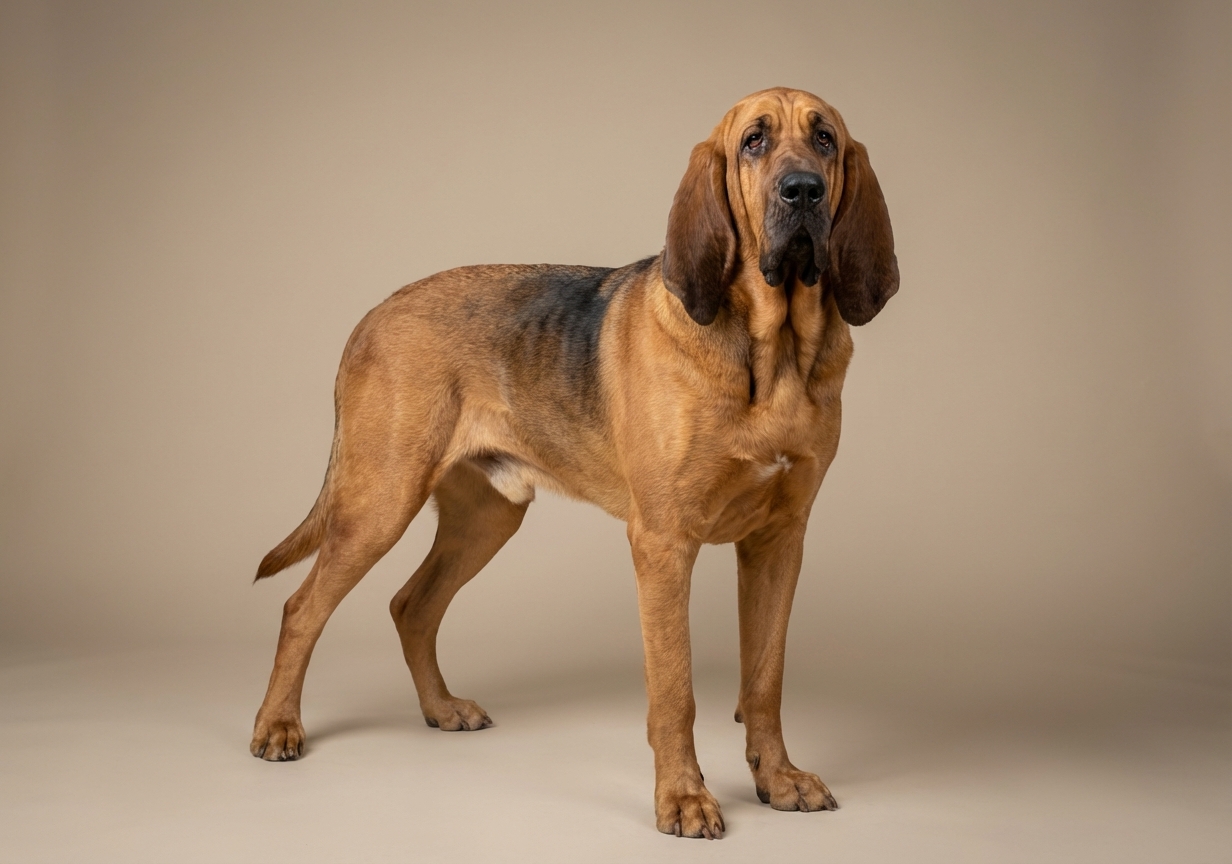
- Typical life span
- 10-12 years
- Size
- Large — from its typical weight
- Weight
- Male
- 41-50 kg
- Female
- 36-45 kg
- Height
- Male
- 64-69 cm
- Female
- 58-64 cm
- FCI status
- Reconhecida pela FCI
- FCI group
- Scent hounds and related breeds
- Origin
- Belgium
- Also called
- Chien de Saint Hubert
- Known hereditary risks
- Not researched yet
About
What is a Bloodhound?
Large, substantial scent hound with a noble, dignified expression, characterized by exceptional tracking ability, distinctive wrinkled face, long drooping ears, loose skin, and pendulous jowls. Renowned for its extraordinary sense of smell and unparalleled tracking abilities.
Bloodhound history and origins
Ancient breed developed by monks at the Abbey of Saint-Hubert in Belgium and France during medieval times. Later refined in England and valued for centuries for tracking game and people, eventually imported to the US for search and rescue work.
Bloodhound appearance and size
Males typically weigh 41-50 kg and stand 64-69 cm at the shoulder; females 36-45 kg and 58-64 cm.
O que diz o padrão da raça
- Criado para
- Scent hound for large game venery, service dog, tracking dog and family dog. It was and it must always remain a hound which due to its remarkable sense of smell is foremost a leash hound, often used not only to follow the trail of wounded game as in the blood scenting trials but also to seek out missing people in police operations. Due to its functional construction, the Bloodhound is endowed with great endurance and also an exceptional nose which allows it to follow a trail over a long distance and difficult terrain without problems
- Comportamento e temperamento
“Gentle, placid, kind and sociable with people. Particularly attached to its owner. Tolerant of kennel companions and other domestic animals. Somewhat reserved and stubborn. Just as sensitive to compliments as to corrections. Never aggressive. Its voice is deep but it rarely barks”
Quoted from FCI standard n°84. It describes the breed the registry recognises, not any individual animal.
Referência da raça de The Dog API.
Características
- Tamanho
- Large
- Necessidade de exercício
- —
- Facilidade de treino
- —
- Queda de pelo
- —
- Cuidados com o pelo
- 3 of 5
- Convivência com crianças
- —
- Custo de manutenção
- —
- Tolera ficar sozinho
- —
- Inteligência
- —
- Saúde da raça
- Not researched yet
Pros & cons
Prós e contras da raça Bloodhound
O que ganha com a raça Bloodhound
- Função declarada no padrão: «Scent hound for large game venery, service dog, tracking dog and family dog»
- O padrão descreve a raça assim: «Gentle, placid, kind and sociable with people»
O que tem de assumir
- Vive menos tempo do que um cão de raça indeterminada — mediana de 9.3 anos em 144 animais, contra 12
Retirado de fontes e não escrito como opinião — investigação de saúde citada, o padrão do próprio registo, e estudos de longevidade revistos por pares. Padrão da raça, FCI; McMillan et al. 2024, median age at death. Os animais de um criador podem diferir de tudo isto, e uma coluna vazia significa que não temos nada desse lado, não que não haja nada a dizer.
Characteristics
Padrão da FCI · Bloodhound
Pelo e cor
Tal como o padrão da FCI o estabelece. Cada linha abaixo está nas palavras do próprio padrão, etiquetada com permissible.
Coat
On the body, the close-lying hair is short, dense, quite harsh and weatherproof.
On the head and ears the hair is very short and soft to the touch.
The underside of the tail is furnished with hair a little longer and coarser
Cor
- Preferred
- Permissible
- Undesirable
- Disqualifying
«Preferred», «permissible», «undesirable» e «disqualifying» — preferida, admissível, indesejável e desqualificante — são as palavras da própria FCI sobre a raça, e ficam em inglês porque é assim que constam do padrão. Descrevem o que o padrão exige — não são uma avaliação de nenhum cão em concreto, nem nossa.
Resumido de FCI standard n°84 — cada etiqueta está nas palavras do próprio padrão, com o veredito passado para a etiqueta ao lado. Leia a cláusula completa na fonte.
O que diz o padrão da raça
- Tamanho
- “Height at withers: The ideal height is 68 cm for males. Tolerance of 4 cm more or less. 62 cm for females. Weight: Males about 46 - 54 kg. Females about 40 – 48 kg. Height and weight must be balanced”
- A FCI indica uma tolerância em torno do valor.
Quoted from FCI standard n°84. It describes the breed the registry recognises, not any individual animal.
O que o padrão penaliza
Aquilo que faz um juiz descontar pontos à raça Bloodhound, e o que a põe fora do ring, nas palavras do próprio registo. Isto descreve o padrão da raça — não é uma lista de verificação para o animal que tem à frente, e um animal de companhia com um defeito desqualificante é um cão que não pode ir a exposição, não um cão doente.
Defeitos desqualificantes
Põem o animal fora do ring por completo.
- General appearance: Lack of breed type.
- Dentition: Over or under shot; wry jaw; crooked mouth.
- Nose and lips: Very lacking in pigment or pink; anything other than black in black and tan dogs; anything other than brown or black in dogs without black saddle or mantle.
- Eyes: Light yellow (hawk eyes).
- Coat colour : Any colours which do not correspond to those described ; too widespread white markings, such as white going up as far as wrists or hocks, or too much white on the forechest ; white patches anywhere other than the forechest, toes and tip of tail, like a white muzzle or a white blaze etc.
- Size: Outside the tolerated limits
Informação ao nível da raça, de The Dog API. Descreve a raça Bloodhound em geral; qualquer animal em concreto pode ser diferente.
Health guide
What to ask for in a Bloodhound
No breed-specific health panel has been written up for the Bloodhound on this platform yet. That is a gap in our records, not a clean bill of health — ask the breeder which hereditary conditions their lines are tested for, and ask to see the results for both parents, dated and from a named laboratory.
Gallery
Ainda sem fotografias
É aqui que vão aparecer as fotografias dos próprios donos de Bloodhound, a partir dos perfis dos animais que mantêm aqui. Ninguém acrescentou ainda nenhuma a uma página pública.
Uma fotografia num perfil de animal fica privada do seu dono. Não colocamos nenhuma aqui sem que nos peçam.
Puppies
No puppies listed right now
No Bloodhound breeder has a record on this platform yet, so there is nothing to list. That is a gap in our coverage, not a fact about the breed.