
- Blue merle, black, red merle, red – all with or without white markings and/or tan markings, with no order of preference.
- The hairline of a white collar does not exceed the point of the withers at the skin.
- White is acceptable on the neck (either in part or as a full collar), chest, legs, muzzle underparts, blaze on head and white extension from underpart up to four inches (10 cm), measuring from a horizontal line at the elbow.
- White on the head should not predominate, and the eyes must be fully surrounded by colour and pigment.
- Merles characteristically become darker with increasing age
About the Australian Shepherd
Origin: United States Of America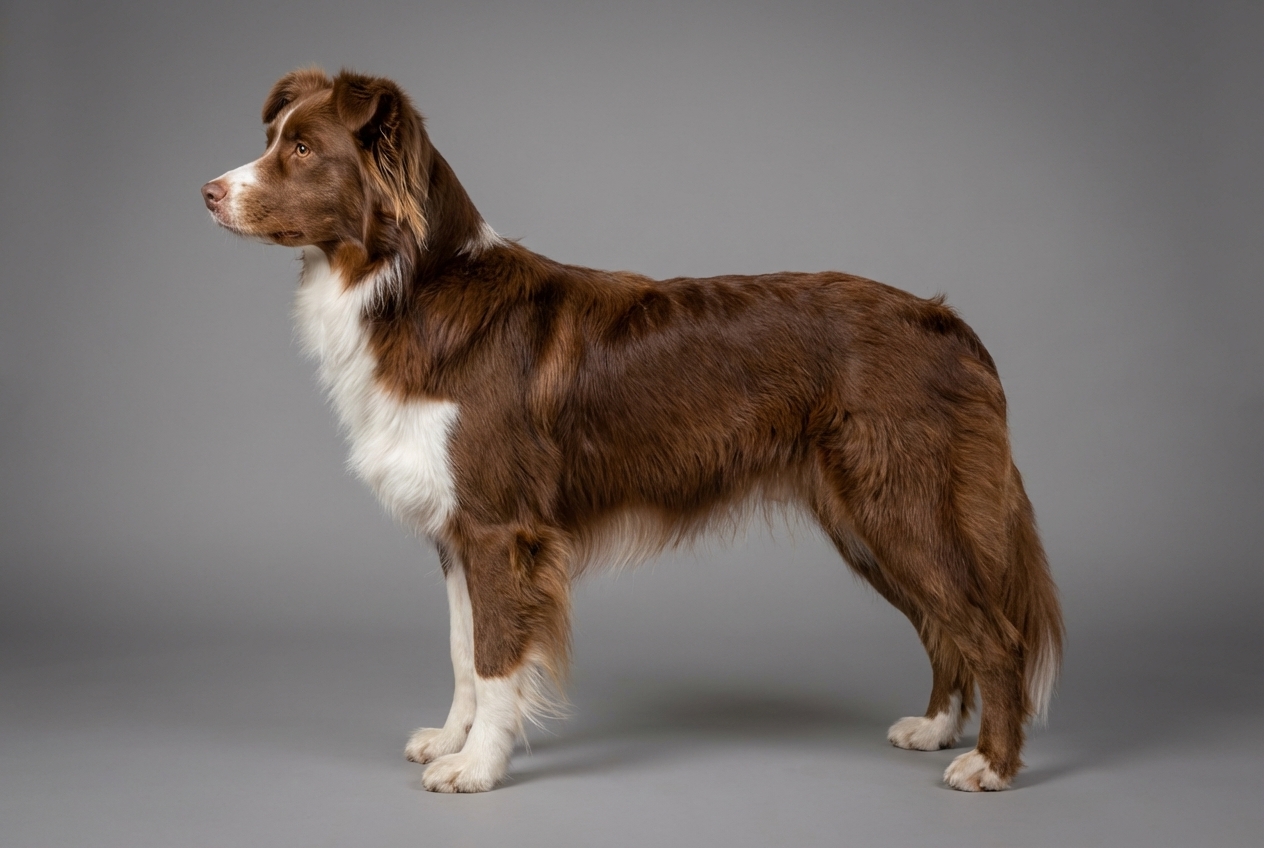
- Typical life span
- 12-15 years
- Size
- Medium — from its typical weight
- Weight
- Male
- 23-29 kg
- Female
- 18-25 kg
- Height
- Male
- 51-58 cm
- Female
- 46-53 cm
- FCI status
- Reconhecida pela FCI
- FCI group
- Sheepdogs and Cattledogs (except Swiss Cattledogs)
- Origin
- United States Of America
- Also called
- Perro Pastor Australiano
- Known hereditary risks
- Not researched yet
About
What is a Australian Shepherd?
Medium-sized, agile herding dog with striking multicolored coat, expressive eyes, and keen herding instincts. Known for their intense work drive and weather-resistant double coat.
Australian Shepherd history and origins
Despite its name, the Australian Shepherd was developed in the American West in the 19th century from Basque shepherd dogs brought by immigrants from the Pyrenees region. The breed's intelligence and versatility made it popular on the rodeo circuit and for ranching work.
Australian Shepherd appearance and size
Males typically weigh 23-29 kg and stand 51-58 cm at the shoulder; females 18-25 kg and 46-53 cm.
O que diz o padrão da raça
- Criado para
- Farm and ranch shepherd dog
- Comportamento e temperamento
“The Australian Shepherd is an intelligent working dog of strong herding and guarding instincts. He is a loyal companion and has the stamina to work all day. With an even disposition, he is good natured, seldom quarrelsome. He may be somewhat reserved in initial meetings”
Quoted from FCI standard n°342. It describes the breed the registry recognises, not any individual animal.
Referência da raça de The Dog API.
Características
- Tamanho
- Medium
- Necessidade de exercícioLida a partir daquilo para que a raça foi criada, nas palavras do próprio registo: “Farm and ranch shepherd dog” Isso é uma função de trabalho, não uma necessidade de exercício medida — as necessidades de um cão em concreto dependem da idade, da saúde e da casa onde vive.
- 4 of 5
- Facilidade de treino
- —
- Queda de pelo
- 3 of 5
- Cuidados com o pelo
- 4 of 5
- Convivência com crianças
- —
- Custo de manutenção
- —
- Tolera ficar sozinho
- —
- Inteligência
- —
- Saúde da raça
- Not researched yet
Pros & cons
Prós e contras da raça Australian Shepherd
O que ganha com a raça Australian Shepherd
- Função declarada no padrão: «Farm and ranch shepherd dog»
- O padrão descreve a raça assim: «The Australian Shepherd is an intelligent working dog of strong herding and guarding instincts»
- Vive mais tempo do que um cão de raça indeterminada — mediana de 13.7 anos em 245 animais, contra 12
O que tem de assumir
- Exige muitos cuidados com o pelo — a descrição do próprio padrão é «There is a moderate mane and frill, more pronounced in dogs than in bitches»
Retirado de fontes e não escrito como opinião — investigação de saúde citada, o padrão do próprio registo, e estudos de longevidade revistos por pares. Padrão da raça, FCI; McMillan et al. 2024, median age at death. Os animais de um criador podem diferir de tudo isto, e uma coluna vazia significa que não temos nada desse lado, não que não haja nada a dizer.
Characteristics
Padrão da FCI · Australian Shepherd
Pelo e cor
Tal como o padrão da FCI o estabelece. Cada linha abaixo está nas palavras do próprio padrão.
Coat
Of medium texture, straight to wavy, weather resistant and of medium length.
The undercoat varies in quantity with variations in climate.
Hair is short and smooth on the head, ears, front of forelegs and below the hocks.
Backs of forelegs and breeches are moderately feathered.
There is a moderate mane and frill, more pronounced in dogs than in bitches
Cor
- Preferred
- Permissible
- Undesirable
- Disqualifying
«Preferred», «permissible», «undesirable» e «disqualifying» — preferida, admissível, indesejável e desqualificante — são as palavras da própria FCI sobre a raça, e ficam em inglês porque é assim que constam do padrão. Descrevem o que o padrão exige — não são uma avaliação de nenhum cão em concreto, nem nossa.
Resumido de FCI standard n°342 — cada etiqueta está nas palavras do próprio padrão, com o veredito passado para a etiqueta ao lado. Leia a cláusula completa na fonte.
O que diz o padrão da raça
- Tamanho
- “Height at the withers: The preferred height for males is 20-23 inches (51-58 cm), females 18-21 inches (46-53 cm). Quality is not to be sacrificed in favour of size”
- A FCI distingue um ideal daquilo que é permitido.
Quoted from FCI standard n°342. It describes the breed the registry recognises, not any individual animal.
O que o padrão penaliza
Aquilo que faz um juiz descontar pontos à raça Australian Shepherd, e o que a põe fora do ring, nas palavras do próprio registo. Isto descreve o padrão da raça — não é uma lista de verificação para o animal que tem à frente, e um animal de companhia com um defeito desqualificante é um cão que não pode ir a exposição, não um cão doente.
Defeitos graves
Contam fortemente contra um exemplar no ring.
- Prick ears and hanging ears.
- Non-typical coats
Defeitos desqualificantes
Põem o animal fora do ring por completo.
- Undershot. Overshot by more than 1/8 inch. Loss of contact caused by short center incisors in an otherwise correct bite shall not be judged undershot. Teeth broken or missing by accident shall not be penalized.
- White body splashes in all colours, which means white on body between withers and tail, on sides between elbows and back of hindquarters
Informação ao nível da raça, de The Dog API. Descreve a raça Australian Shepherd em geral; qualquer animal em concreto pode ser diferente.
Health guide
What to ask for in a Australian Shepherd
No breed-specific health panel has been written up for the Australian Shepherd on this platform yet. That is a gap in our records, not a clean bill of health — ask the breeder which hereditary conditions their lines are tested for, and ask to see the results for both parents, dated and from a named laboratory.
Gallery
Ainda sem fotografias
É aqui que vão aparecer as fotografias dos próprios donos de Australian Shepherd, a partir dos perfis dos animais que mantêm aqui. Ninguém acrescentou ainda nenhuma a uma página pública.
Uma fotografia num perfil de animal fica privada do seu dono. Não colocamos nenhuma aqui sem que nos peçam.
Puppies
No puppies listed right now
No Australian Shepherd breeder has a record on this platform yet, so there is nothing to list. That is a gap in our coverage, not a fact about the breed.