- 2 or 3 bands of colour on each hair with dark tips for preference.
About the Abyssinian
Origin: Egypt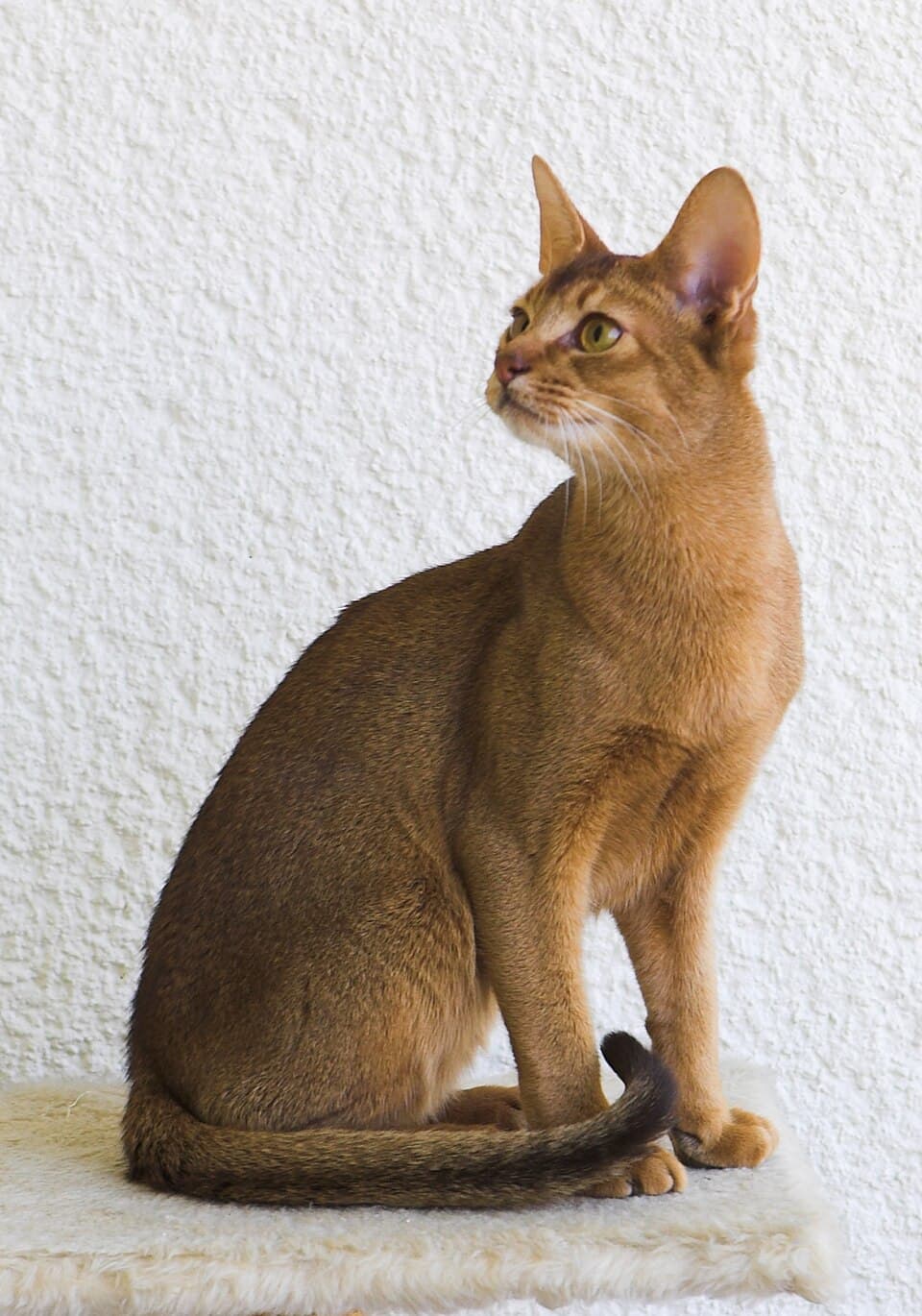
- Typical life span
- 14-17 years
- Size
- Medium — from its typical weight
- Weight
- 3.6-5.4 kg
- Height
- 25-30 cm
- Registry status
- Reconhecida pela TICA
- Breed group
- Short-haired
- Origin
- Egypt
- Known hereditary risks
- 6 documented conditions, with the test for each
About
What is a Abyssinian?
Medium-sized, elegant cat with a distinctive ticked coat pattern giving a wild appearance. Known for its athletic build, almond-shaped eyes, and highly active, curious personality.
Abyssinian history and origins
One of the oldest known cat breeds, believed to have originated in the coastal regions of the Indian Ocean and Southeast Asia. The breed was developed in Great Britain from cats imported from Abyssinia (now Ethiopia) in the 1860s.
Abyssinian appearance and size
Typically 3.6-5.4 kg and 25-30 cm at the shoulder — published as one range rather than separately for males and females.
Abyssinian temperament and personality
Generally described as active, energetic, independent, intelligent, gentle, curious and playful.
That is the breed in general, not a promise about one animal. Ask the breeder what their own line is like, and meet the parents before you decide.
Referência da raça de The Cat API.
Características
- Tamanho
- Medium
- Necessidade de exercício
- —
- Facilidade de treino
- —
- Queda de pelo
- —
- Cuidados com o pelo
- 2 of 5
- Convivência com crianças
- —
- Custo de manutenção
- —
- Tolera ficar sozinho
- —
- Inteligência
- —
- Saúde da raça
- 6 conditions documented
Pros & cons
Prós e contras da raça Abyssinian
O que ganha com a raça Abyssinian
- Exige poucos cuidados com o pelo, adequado a quem tem pouco tempo — o pelo é «Short, fine and close lying. Resilient to the touch.»
- Descrito habitualmente como: «Active, Energetic, Independent, Intelligent»
O que tem de assumir
- Estão documentadas 4 doenças hereditárias graves, sobretudo em olhos e rins e vias urinárias. O separador do guia de saúde tem o exame a pedir para cada uma.
Retirado de fontes e não escrito como opinião — investigação de saúde citada, o padrão do próprio registo, e estudos de longevidade revistos por pares. Padrão da raça, FIFe; The Cat API; UC Davis VGL — PRA rdAc (CEP290) test. Os animais de um criador podem diferir de tudo isto, e uma coluna vazia significa que não temos nada desse lado, não que não haja nada a dizer.
Characteristics
Padrão da FIFe · Abyssinian
Pelo e cor
Tal como o padrão da FIFe o estabelece. Cada linha abaixo está nas palavras do próprio padrão.
Coat
Short, fine and close lying.
Resilient to the touch.
Cor
- Preferred
- Permissible
- Undesirable
- Disqualifying
«Preferred», «permissible», «undesirable» e «disqualifying» — preferida, admissível, indesejável e desqualificante — são as palavras da própria FIFe sobre a raça, e ficam em inglês porque é assim que constam do padrão. Descrevem o que o padrão exige — não são uma avaliação de nenhum cão em concreto, nem nossa.
Resumido de FIFe standard ABY — cada etiqueta está nas palavras do próprio padrão, com o veredito passado para a etiqueta ao lado. Leia a cláusula completa na fonte.
Temperamento
ActiveEnergeticIndependentIntelligentGentleCuriousPlayful
Informação ao nível da raça, de The Cat API. Descreve a raça Abyssinian em geral; qualquer animal em concreto pode ser diferente.
Health guide
Health & screening guide for the Abyssinian
Riscos hereditários conhecidos na raça Abyssinian, e a documentação específica a pedir a qualquer criador antes de pagar um sinal. Um criador responsável tem esta documentação à mão; desviar a conversa é um mau indício.
6 doenças documentadasIsto é literatura ao nível da raça, não aconselhamento veterinário sobre um animal em concreto — o seu veterinário conhece o animal.
Health checklist (PDF)Bones & joints
Patellar luxation
Monitor
A dislocating kneecap that produces a bow-legged or knock-kneed gait and can worsen over the cat's first one to two years. Abyssinians are named as one of the breeds with rising reported incidence, alongside Devon Rex and Chartreux.
O que pedir
No DNA test exists — ask for a veterinary orthopaedic exam (kneecap palpation) on both parents
Protruding sternum
Monitor
An outward or inward bend in the lower chest bone. It is seen mostly in oriental-bodied breeds but is also documented, less often, in Abyssinians. Outward protrusion is typically harmless; an inward one can press on the chest cavity and needs veterinary assessment.
O que pedir
No DNA test exists — ask for a veterinary chest exam noting sternum conformation, on both parents
Eyes
Progressive retinal atrophy (PRA rdAc, CEP290)
Serious
An inherited late-onset retinal disease: affected kittens see normally at birth, but photoreceptor degeneration begins around seven months of age and most cats are blind by three to five years old. There is no treatment, so a breeding cat's genotype is the only way to know a kitten's risk before it is sold.
O que pedir
UC Davis VGL PRA rdAc (CEP290) DNA test result, on both parents
Progressive retinal atrophy (PRA Rdy, CRX)
Serious
A separate, rarer and more aggressive inherited blindness in the same breed: affected kittens already show retinal degeneration by seven weeks old. It is inherited as a dominant trait, so a single copy of the mutation causes disease, unlike the more common rdAc form.
O que pedir
UC Davis VGL PRA Rdy (CRX) DNA test result, on both parents
Kidneys & urinary
Renal amyloidosis
Serious
A kidney disease in which insoluble protein deposits build up in the kidneys, usually appearing in young adults and sometimes progressing to kidney failure within a year of diagnosis. It is well documented as prevalent specifically in this breed, but despite extensive study the mode of inheritance has not been established, so there is no DNA test.
O que pedir
No DNA test exists — ask for the breeding line's known family history of kidney disease, and recent urinalysis/kidney bloodwork on the parents
Blood
Erythrocyte pyruvate kinase (PK) deficiency
Serious
An inherited haemolytic anaemia caused by low activity of the pyruvate kinase enzyme in red blood cells. Onset and severity are variable — some cats have intermittent lethargy and weight loss, others become jaundiced — so a clear DNA result is the only way to rule it out before breeding.
O que pedir
UC Davis VGL PK deficiency DNA test result, on both parents
Gallery
Ainda sem fotografias
É aqui que vão aparecer as fotografias dos próprios donos de Abyssinian, a partir dos perfis dos animais que mantêm aqui. Ninguém acrescentou ainda nenhuma a uma página pública.
Uma fotografia num perfil de animal fica privada do seu dono. Não colocamos nenhuma aqui sem que nos peçam.
Kittens
No kittens listed right now
That is not the same as none existing. Publishing a litter is part of a breeder's subscription here, so a Abyssinian breeder can have a litter and no listing — ask them directly.
See Abyssinian breeders