- Permissible: All colour varieties and patterns, including those with white
- Permissible: Any amount of white
About the Peterbald
Origin: Russia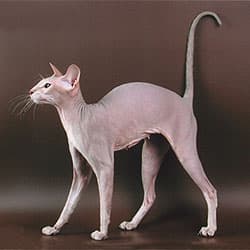
View Peterbald breedersSee Peterbald kittens
No breeder is on record here yet. Portugal’s FIFe member club does not list this breed in its breeder directory at all, so an absence here says nothing about whether anyone breeds it in Portugal.
- Typical life span
- 10-15 years
- Size
- Medium — from its typical weight
- Weight
- 3.2-6.4 kg
- Height
- 25-36 cm
- Registry status
- Recognised by TICA
- Breed group
- Hairless
- Origin
- Russia
- Known hereditary risks
- 2 documented conditions, with the test for each
About
What is a Peterbald?
Medium-sized, elegant hairless or partially haired cat with long narrow head and large ears. Russian breed related to Oriental type.
Peterbald history and origins
Developed in St. Petersburg, Russia in 1994 by crossing a Don Sphynx with an Oriental Shorthair. Combines Oriental elegance with hairlessness. Can range from completely bald to short coat.
Peterbald appearance and size
Typically 3.2-6.4 kg and 25-36 cm at the shoulder — published as one range rather than separately for males and females.
Peterbald temperament and personality
Generally described as highly intelligent, affectionate, playful, active, athletic and social.
That is the breed in general, not a promise about one animal. Ask the breeder what their own line is like, and meet the parents before you decide.
Breed reference from The Cat API.
Characteristics
- Size
- Medium
- Exercise needs
- —
- Easy to train
- —
- Amount of shedding
- 1 of 5
- Grooming needs
- 1 of 5
- Good with children
- —
- Cost to keep
- —
- Tolerates being alone
- —
- Intelligence
- —
- Health of breed
- 2 conditions documented
Pros & cons
Pros & cons for the Peterbald
What you get with the Peterbald
- Low grooming needs, fitting for a busy owner — the coat is “Appears hairless. Short, soft, fine hair on the muzzle, at the base of the ears, legs and…”
- Commonly described as: “Highly intelligent, Affectionate, Playful, Active”
What you are taking on
- One serious inherited condition is documented, in eyes. The health guide tab has the test to ask a breeder for.
Drawn from sources rather than written as an opinion — cited health research, the registry’s own standard, and peer-reviewed longevity. FIFe breed standard; The Cat API; UC Davis VGL — Progressive Retinal Atrophy (PRA rdAc). One breeder’s animals can differ from any of it, and an empty column means we hold nothing for that side rather than that there is nothing to say.
Characteristics
FIFe standard · Peterbald
Coat and colour
As the FIFe standard sets it out. Every line below is the standard’s own wording, tagged permissible.
Coat
Appears hairless.
Short, soft, fine hair on the muzzle, at the base of the ears, legs and tail that feels like velvet may occur, mainly on young cats.
Colour
- Preferred
- Permissible
- Undesirable
- Disqualifying
Preferred, permissible, undesirable and disqualifying are FIFe’s own words about the breed. They describe what the standard asks for — not an assessment of any individual dog, and not ours.
Shortened from FIFe standard PEB — each label is the standard’s own wording with the verdict lifted into the tag beside it. Read the full clause at source.
Temperament
IntelligentAffectionatePlayfulActiveAthleticSocial
Breed-level information from The Cat API. It describes the Peterbald in general; any individual animal can differ.
Health guide
Health & screening guide for the Peterbald
Known hereditary risks for the Peterbald breed, and the specific documentation to request from any breeder before paying a deposit. A responsible breeder will have these readily available; deflection is a red flag.
2 conditions documentedThis is breed-level literature, not veterinary advice about an individual animal — your vet knows the animal.
Health checklist (PDF)Eyes
Progressive retinal atrophy (PRA-rdAc / CEP290)
Serious
This inherited retinal disease causes slow, progressive vision loss and eventual blindness. It is usually marketed as an Abyssinian condition, but a large-scale genetic survey of over 11,000 cats found the same mutation at meaningful frequency in Peterbald, consistent with its Oriental Shorthair and Siamese ancestry.
What to ask for
PRA-rdAc (CEP290) DNA test result for both parents (UC Davis VGL or an equivalent laboratory)
Skin & coat
Hairlessness-related skin sensitivity (sunburn, seborrhoea)
MonitorInherent to the breed
Without a coat, skin oil that would normally be absorbed by fur instead builds up on the skin surface, and unprotected skin sunburns easily; both can lead to greasy build-up, irritation or secondary skin infections without regular bathing and sun avoidance. This follows directly from coat loss itself rather than a separate disease, so it applies to any hairless cat and is documented in detail in the genetically distinct but phenotypically similar Sphynx.
What to ask for
No DNA test applies — this follows directly from the visible coat-loss trait, not a hidden mutation. Ask the breeder about their skin-care routine (bathing frequency, sun-exposure precautions) rather than a lab document.
Gallery
No photographs yet
This is where Peterbald owners’ own photographs will go, from the pet profiles they keep here. Nobody has added one to a public page yet.
A photograph in a pet profile stays private to its owner. We will not put one here unless they ask us to.
Kittens
No kittens listed right now
No Peterbald breeder has a record on this platform yet, so there is nothing to list. That is a gap in our coverage, not a fact about the breed.