- Permissible: All colour varieties, including all colour varieties with white
- except pointed patterns and chocolate and lilac, cinnamon and fawn.
- Permissible: Any amount of white, i.e. a white blaze, white locket, white chest, white on the belly, white on the paws, etc
About the Maine Coon
Origin: United States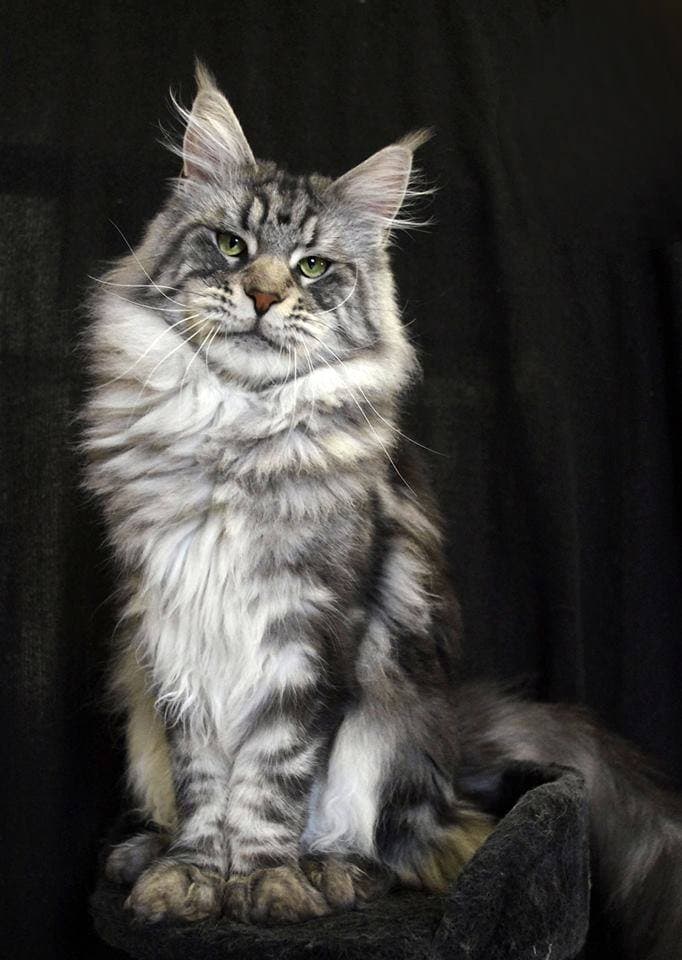
- Typical life span
- 12-15 years
- Size
- Large — from its typical weight
- Weight
- 6.8-11.3 kg
- Height
- 38-64 cm
- Registry status
- Recognised by TICA
- Breed group
- Long-haired
- Origin
- United States
- Known hereditary risks
- 4 documented conditions, with the test for each
About
What is a Maine Coon?
Large to very large, muscular cat with long shaggy coat, tufted ears, and bushy tail. One of the largest domestic cat breeds.
Maine Coon history and origins
One of the oldest natural breeds in North America, developed in Maine. Legend says descended from Marie Antoinette's cats. Adapted to harsh New England winters with thick waterproof coat. State cat of Maine.
Maine Coon appearance and size
Typically 6.8-11.3 kg and 38-64 cm at the shoulder — published as one range rather than separately for males and females.
Maine Coon temperament and personality
Generally described as adaptable, intelligent, loving, gentle, independent, playful and friendly.
That is the breed in general, not a promise about one animal. Ask the breeder what their own line is like, and meet the parents before you decide.
Breed reference from The Cat API.
Characteristics
- Size
- Large
- Exercise needs
- —
- Easy to train
- —
- Amount of shedding
- 5 of 5
- Grooming needs
- 4 of 5
- Good with children
- —
- Cost to keep
- —
- Tolerates being alone
- —
- Intelligence
- —
- Health of breed
- 4 conditions documented
Pros & cons
Pros & cons for the Maine Coon
What you get with the Maine Coon
- Commonly described as: “Adaptable, Intelligent, Loving, Gentle”
What you are taking on
- 2 serious inherited conditions are documented, mainly in heart & circulation and brain & nerves. The health guide tab has the test to ask for on each.
- High grooming needs — the standard’s own description is “A frill is expected. Texture silky. Coat has distinct body, falling smoothly.”
- Expect a lot of shedding — “Length of coat and density of undercoat vary with seasons.”
- Shorter-lived than a non-pedigree cat — median 9.76 years across 69 recorded deaths, against 13.01
Drawn from sources rather than written as an opinion — cited health research, the registry’s own standard, and peer-reviewed longevity. The Cat API; UC Davis VGL — Hypertrophic Cardiomyopathy (HCM) in Maine Coons; FIFe breed standard; Teng et al. 2024, median age at death. One breeder’s animals can differ from any of it, and an empty column means we hold nothing for that side rather than that there is nothing to say.
Characteristics
FIFe standard · Maine Coon
Coat and colour
As the FIFe standard sets it out. Every line below is the standard’s own wording, tagged permissible.
Coat
All weather coat.
Dense.
Short on head, shoulders and legs, becoming gradually longer down the back and sides, with long, full shaggy baggy trousers on the hind legs and belly fur.
A frill is expected.
Texture silky.
Coat has distinct body, falling smoothly.
The undercoat is soft and fine, covered by the firm smooth outercoat.
Length of coat and density of undercoat vary with seasons.
Colour
- Preferred
- Permissible
- Undesirable
- Disqualifying
Preferred, permissible, undesirable and disqualifying are FIFe’s own words about the breed. They describe what the standard asks for — not an assessment of any individual dog, and not ours.
Shortened from FIFe standard MCO — each label is the standard’s own wording with the verdict lifted into the tag beside it. Read the full clause at source.
TICA divisions
TICA lists the Maine Coon in these divisions. They are the registry's own groupings — usually hair length — not a list of colours: no registry we hold publishes one. Ask a breeder what colours their line produces.
- Polydactyl
Temperament
AdaptableIntelligentLovingGentleIndependentPlayfulFriendly
Breed-level information from The Cat API. It describes the Maine Coon in general; any individual animal can differ.
Health guide
Health & screening guide for the Maine Coon
Known hereditary risks for the Maine Coon breed, and the specific documentation to request from any breeder before paying a deposit. A responsible breeder will have these readily available; deflection is a red flag.
4 conditions documentedThis is breed-level literature, not veterinary advice about an individual animal — your vet knows the animal.
Health checklist (PDF)Heart & circulation
Hypertrophic cardiomyopathy (HCM) — MYBPC3 A31P variant
Serious
A mutation in the MYBPC3 gene thickens the heart muscle and can cause sudden cardiac death. It is found only in Maine Coons (not in other pedigree breeds), at roughly 30-40% carrier prevalence in some populations. Penetrance depends heavily on genotype: cats with two copies have high penetrance — almost all develop HCM by 5 years old — while cats with a single copy carry a much lower and later risk, so the two results are not equivalent.
What to ask for
UC Davis VGL Maine Coon HCM DNA test (MYBPC3 A31P) on both parents. The mutation does not explain all HCM in the breed, so a clear DNA result does not replace periodic cardiac ultrasound (echocardiogram) of the breeding cats.
Bones & joints
Hip dysplasia
Monitor
Malformation of the hip joint causing laxity, pain and early osteoarthritis. Documented at roughly 25-37% prevalence in OFA-screened Maine Coons, worsening with age and body mass. There is no single-gene DNA test — it is polygenic and diagnosed by radiograph.
What to ask for
Hip radiographs scored by OFA (a grade) or PennHIP (a laxity measurement) on both parents — not a DNA test.
Brain & nerves
Spinal muscular atrophy (SMA)
Serious
A recessive loss of motor neurons in the lower spinal cord. Affected kittens are normal at birth and develop unsteady gait and hind-limb muscle wasting from around 3-4 months old. It does not shorten life, but it is a permanent, disabling condition.
What to ask for
UC Davis VGL Maine Coon SMA DNA test on both parents.
Blood
Erythrocyte pyruvate kinase (PK) deficiency
Monitor
A recessive enzyme defect causing intermittent haemolytic anaemia, with highly variable age of onset and severity. Maine Coon is one of the breeds UC Davis names as appropriate for this test.
What to ask for
UC Davis VGL PK deficiency DNA test on both parents.
How long the Maine Coon lives, in the records
Median age at death 9,8 years
Middle half of deaths between 5,1 and 14,1 years, from 69 recorded deaths. 10,1% of them were before age two.
Computed from United Kingdom veterinary records covering 7936 deaths. This is an age at death, not a life expectancy: half the cats of this breed in the records died younger.
Dataset: O'Neill, D. & Teng, K.T. (2024), Figshare, doi:10.6084/m9.figshare.25006802, CC BY 4.0. Teng, K.T., Brodbelt, D.C., Church, D.B. & O'Neill, D.G. (2024) Life tables of annual life expectancy and risk factors for mortality in cats in the United Kingdom. Journal of Feline Medicine and Surgery 26(5).
Gallery
No photographs yet
This is where Maine Coon owners’ own photographs will go, from the pet profiles they keep here. Nobody has added one to a public page yet.
A photograph in a pet profile stays private to its owner. We will not put one here unless they ask us to.
Kittens
No kittens listed right now
That is not the same as none existing. Publishing a litter is part of a breeder's subscription here, so a Maine Coon breeder can have a litter and no listing — ask them directly.
See Maine Coon breeders