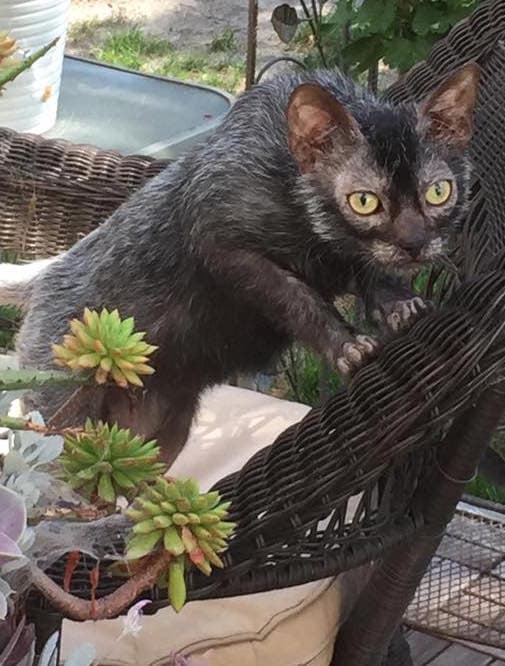
Medium-sized cat with unique partially hairless coat resembling a werewolf. Distinctive appearance with varying amounts of fur.
Lykoi history and origins
Developed from natural mutations appearing in feral cat populations. First intentionally bred in 2011. Name comes from Greek word for wolf. TICA recognized breed.
Lykoi temperament and personality
Generally described as personable, playful, mischievous, friendly, cheerful e affectionate.
That is the breed in general, not a promise about one animal. Ask the breeder what their own line is like, and meet the parents before you decide.
Breed reference from The Cat API.
Pros & cons for the Lykoi
What you get with the Lykoi
Commonly described as: “Personable, Playful, Mischievous, Friendly”
What you are taking on
One serious inherited condition is documented, in blood. The health guide tab has the test to ask a breeder for.
High grooming needs — the standard’s own description is “From short to semi long coat. Presents the singularity of having sparse coat.”
Drawn from sources, not opinion: The Cat API; Anderson et al. 2022, PLOS Genetics (Table 2 and S4 Table, Lykoi row); FIFe breed standard. An empty column means we hold nothing for that side, not that there is nothing to say.
Lykoi characteristics
The Lykoi standard is published by the FIFe (Fédération Internationale Féline), the international federation of pedigree-cat clubs, and it is what show judges apply. This section sums up what it says about coat and colour. It does not assess any one animal: use it to know what to ask the breeder.
Coat and colour
Coat
From short to semi long coat.
Presents the singularity of having sparse coat.
Undercoat almost absent.
The quantity of coat varies from one cat to another and depending on the season.
Texture is soft.
Colour
Coat is of the base colour, but showing a unique characteristic called "roan", which is a mixture of base colours and withe hairs in a proportion from 30% to 70%.
The ideal should be a 50/50 giving the coat a "salt and pepper" look.
White hairs are all over the body.
Shortened from FIFe standard LYO — each label is the standard’s own wording with the verdict lifted into the tag beside it. Read the full clause at source. FIFe lists this standard’s last modification as 2023. Text read on 31 ago 2026.
Where to check this at FIFe
The colour varieties FIFe recognises for this breed are listed, with their EMS codes, in the table at the end of its standard. FIFe describes each colour group in the General Part of its standards.
FIFe recognises this breed only provisionally (2023–2027), so its standard may still change.
Ask the breeder
Is this kitten's colour on the pedigree, and one the standard admits?
Does the parents' pedigree state their coat type and colour?
The colours and patterns the standard admits, and what it prefers, discourages or disqualifies in each. An accepted colour says nothing about health. Quotations from the FIFe are in English, as the standard publishes them; the headings are ours.
Temperament
FriendlyPlayfulMischievous
Health guide
Health & screening guide for the Lykoi
Known hereditary risks for the Lykoi breed, and the specific documentation to request from any breeder before paying a deposit. A responsible breeder will have these readily available; deflection is a red flag.
2 conditions documentedThis is breed-level literature, not veterinary advice about an individual animal — your vet knows the animal.
Breed-level information from The Cat API. It describes the Lykoi in general; any individual animal can differ.
Common in this breed
An inherited haemolytic anaemia: red blood cells break down early, causing bouts of lethargy, weakness, weight loss and sometimes jaundice, with onset and severity that vary from cat to cat. It is recessive, so a kitten is affected only if it inherits a copy from each parent. A 2022 screen of over 11,000 cats found one copy of the mutation in 7 of 104 Lykoi, roughly one in fifteen, and none with two copies.
What to ask for
UC Davis VGL PK deficiency DNA test result, on both parents
Documented in this breed, but no source says how many of its dogs carry or have them. That is a gap in the evidence, not a sign they are rare.
Skin & coat
Cutaneous adnexal polycystic syndrome (CAPS)
Monitor
A skin condition so far described only in the Lykoi: cysts form in the hair follicles, the oil (sebaceous) glands and the sweat glands, showing as white and black papules and blackheads. It ranges from a few scattered spots to widespread nodules that can ulcerate and become infected. In the first study, of 10 affected Lykoi from France, Belgium, the UK and Canada, signs began between one and four years old; six of the ten were severely affected, and five of those six had a secondary bacterial infection. None showed pain, itching or illness elsewhere. The authors presume a genetic cause linked to the Hairless (HR) gene variants that give the Lykoi its coat, but no HR genotype explained who was affected, and small cysts were found even in a healthy-looking Lykoi, so they question whether any Lykoi is truly free of it. They note that numerous Lykoi worldwide have been reported with extensive cysts, but no study has measured how common it is.
What to ask for
No DNA test exists, and the Hairless genotype does not predict it. Ask whether either parent, or earlier kittens from the line, developed papules, blackheads or skin cysts; signs can first appear as late as four years old.