- All colour varieties with the exception of colourpoints, chocolate, cinnamon, fawn, lilac and the same combined with white.
- Permissible: Any amount of white, i.e. a white blaze, white locket, white chest, white on the belly, white on the paws, etc
About the Kurilian Bobtail
Origin: Russia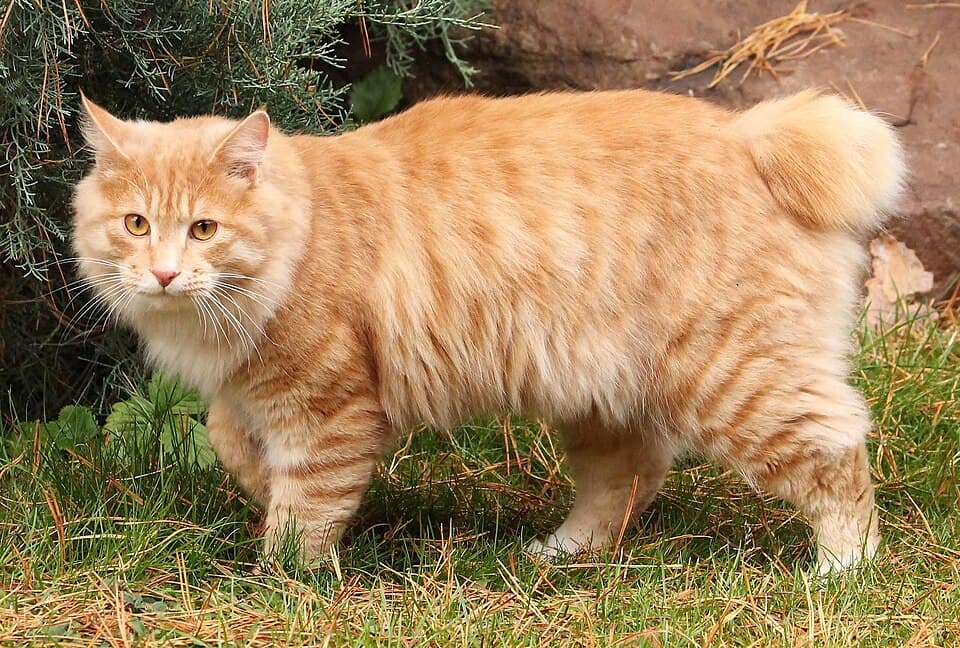
View Kurilian Bobtail breedersSee Kurilian Bobtail kittens
1 breeder is on record here. Portugal’s FIFe member club does not list this breed in its breeder directory at all, so an absence here says nothing about whether anyone breeds it in Portugal.
- Typical life span
- 15-20 years
- Size
- Medium — from its typical weight
- Weight
- 3.6-6.8 kg
- Height
- 28-36 cm
- Registry status
- Recognised by TICA
- Breed group
- Short/Long-hair
- Origin
- Russia
- Known hereditary risks
- None well documented
About
What is a Kurilian Bobtail?
Medium to large muscular cat with distinctive pom-pom bobbed tail. Natural breed from Russian Kuril Islands.
Kurilian Bobtail history and origins
Natural breed originating from the Kuril Islands between Russia and Japan. Adapted to harsh island conditions with excellent hunting and fishing skills. Different bobbed tail mutation from Japanese Bobtail.
Kurilian Bobtail appearance and size
Typically 3.6-6.8 kg and 28-36 cm at the shoulder — published as one range rather than separately for males and females.
Kurilian Bobtail temperament and personality
Generally described as independent, highly intelligent, clever, inquisitive, sociable, playful, trainable and gentle.
That is the breed in general, not a promise about one animal. Ask the breeder what their own line is like, and meet the parents before you decide.
Breed reference from The Cat API.
Characteristics
- Size
- Medium
- Exercise needs
- —
- Easy to train
- —
- Amount of shedding
- 3 of 5
- Grooming needs
- 4 of 5
- Good with children
- —
- Cost to keep
- —
- Tolerates being alone
- —
- Intelligence
- —
- Health of breed
- Nothing hereditary documented
Pros & cons
Pros & cons for the Kurilian Bobtail
What you get with the Kurilian Bobtail
- Commonly described as: “Independent, Highly intelligent, Clever, Inquisitive”
What you are taking on
- High grooming needs — the standard’s own description is “A fully coated cat is desirable and has a shirtfront, a full frill, and breeches.”
Drawn from sources rather than written as an opinion — cited health research, the registry’s own standard, and peer-reviewed longevity. The Cat API; FIFe breed standard. One breeder’s animals can differ from any of it, and an empty column means we hold nothing for that side rather than that there is nothing to say.
Characteristics
FIFe standard · Kurilian Bobtail
Coat and colour
As the FIFe standard sets it out. Every line below is the standard’s own wording, tagged permissible.
Coat
Dense, rather fine in texture.
A fully coated cat is desirable and has a shirtfront, a full frill, and breeches.
Notes
- Shorthair: short, with well-developed guard hair, firm awn hair and moderate undercoat.
- Longhair: medium long, with slight guard hair, well-developed awn hair and slight undercoat.
Colour
- Preferred
- Permissible
- Undesirable
- Disqualifying
Preferred, permissible, undesirable and disqualifying are FIFe’s own words about the breed. They describe what the standard asks for — not an assessment of any individual dog, and not ours.
Shortened from FIFe standard KBL/KBS — each label is the standard’s own wording with the verdict lifted into the tag beside it. Read the full clause at source.
TICA divisions
TICA lists the Kurilian Bobtail in these divisions. They are the registry's own groupings — usually hair length — not a list of colours: no registry we hold publishes one. Ask a breeder what colours their line produces.
- Longhair
Temperament
IndependentIntelligentCleverInquisitiveSociablePlayfulTrainableGentle
Breed-level information from The Cat API. It describes the Kurilian Bobtail in general; any individual animal can differ.
Health guide
Health & screening guide for the Kurilian Bobtail
Nothing hereditary is documented for the Kurilian Bobtail breed, but there is still specific documentation to request from any breeder before paying a deposit. A responsible breeder will have these readily available; deflection is a red flag.
No breed-specific hereditary disease is documented for the Kurilian Bobtail in the sources searched. The breed's own naturally short, curled tail has not been genetically characterised in the peer-reviewed literature found: OMIA's record of the HES7 tail variant responsible for the Japanese Bobtail's tail explicitly describes that mutation as private to the Japanese Bobtail, and the Kurilian Bobtail was not part of the sample in either of the two founding genetic studies on cat bobtails, so its own tail mutation should not be assumed to be the same gene as the Japanese Bobtail's (or the Manx's) without direct evidence. UC Davis Veterinary Genetics Laboratory's Kurilian Bobtail Shorthair test list contains only coat-colour, blood-type and parentage tests — no health test is offered or tagged for this breed. This absence reflects how little the breed has been formally studied, not evidence that it is unusually healthy.
What to ask for anyway
- Cardiologist echocardiogram of both parents (general hypertrophic cardiomyopathy screening)
- Physical or radiographic exam of the tail only if a kink looks unusually severe — mainly to rule a problem out, not because one is expected
- PK deficiency or PKD1 DNA testing only if the line has known crossbreeding with a breed that carries those specific mutations
Gallery
No photographs yet
This is where Kurilian Bobtail owners’ own photographs will go, from the pet profiles they keep here. Nobody has added one to a public page yet.
A photograph in a pet profile stays private to its owner. We will not put one here unless they ask us to.
Kittens
No kittens listed right now
That is not the same as none existing. Publishing a litter is part of a breeder's subscription here, so a Kurilian Bobtail breeder can have a litter and no listing — ask them directly.
See Kurilian Bobtail breeders