


- All colour varieties and patterns are recognised, including those with white.
Permissible
- Any amount of white
4 breeders are on record here.
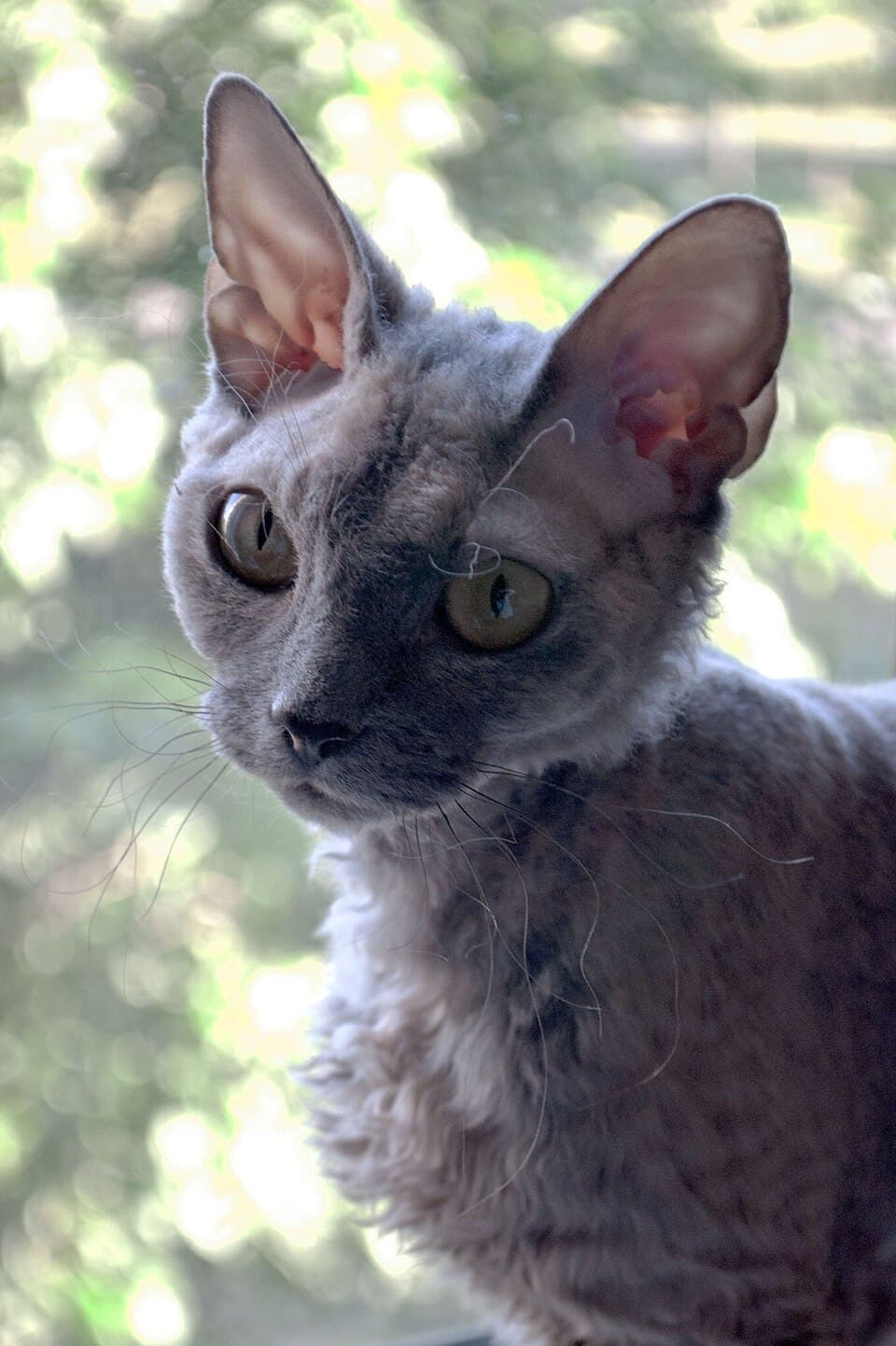
Small to medium cat with distinctive wavy coat, large ears, and pixie-like face. Known for its mischievous, dog-like personality.
Originated in Devon, England in 1960 from a curly-coated feral cat. Different mutation from Cornish Rex despite similar appearance. Known as the 'pixie cat' for its elfin features.
Generally described as highly interactive, mischievous, loyal, social, playful e affectionate.
That is the breed in general, not a promise about one animal. Ask the breeder what their own line is like, and meet the parents before you decide.
Breed reference from The Cat API.
Drawn from sources, not opinion: The Cat API; UC Davis Veterinary Genetics Laboratory; FIFe breed standard. An empty column means we hold nothing for that side, not that there is nothing to say.
The Devon Rex standard is published by the FIFe (Fédération Internationale Féline), the international federation of pedigree-cat clubs, and it is what show judges apply. This section sums up what it says about coat and colour. It does not assess any one animal: use it to know what to ask the breeder.
Very short and fine
soft, wavy and/or curly, with or without guard hairs.
Bare patches are permitted only in cats up to 12 months.
Permissible
Shortened from FIFe standard DRX — each label is the standard’s own wording with the verdict lifted into the tag beside it. Read the full clause at source. FIFe lists this standard’s last modification as 2026. Text read on 31 ago 2026.
A tick means FIFe recognises that colour in at least one variety with that pattern. It does not mean every combination is recognised.
| Colour | Solid | Tabby | Smoke | Silver | Golden | Pointed | With white |
|---|---|---|---|---|---|---|---|
| Black | Accepted | Accepted | Accepted | Accepted | Accepted | Accepted | Accepted |
| Blue | Accepted | Accepted | Accepted | Accepted | Accepted | Accepted | Accepted |
| Chocolate | Accepted | Accepted | Accepted | Accepted | Accepted | Accepted | Accepted |
| Lilac | Accepted | Accepted | Accepted | Accepted | Accepted | Accepted | Accepted |
| Cinnamon | Accepted | Accepted | Accepted | Accepted | Accepted | Accepted | Accepted |
| Fawn | Accepted | Accepted | Accepted | Accepted | Accepted | Accepted | Accepted |
| Red | Accepted | Accepted | Accepted | Accepted | Accepted | Accepted | Accepted |
| Cream | Accepted | Accepted | Accepted | Accepted | Accepted | Accepted | Accepted |
| Black tortie | Accepted | Accepted | Accepted | Accepted | Accepted | Accepted | Accepted |
| Blue tortie | Accepted | Accepted | Accepted | Accepted | Accepted | Accepted | Accepted |
| Chocolate tortie | Accepted | Accepted | Accepted | Accepted | Accepted | Accepted | Accepted |
| Lilac tortie | Accepted | Accepted | Accepted | Accepted | Accepted | Accepted | Accepted |
| Cinnamon tortie | Accepted | Accepted | Accepted | Accepted | Accepted | Accepted | Accepted |
| Fawn tortie | Accepted | Accepted | Accepted | Accepted | Accepted | Accepted | Accepted |
Read from the table at the end of the FIFe standard. Smoke, silver, golden and corin are FIFe’s own names; the exact EMS codes and the eye colours are in the standard.
The colour varieties FIFe recognises for this breed are listed, with their EMS codes, in the table at the end of its standard. FIFe describes each colour group in the General Part of its standards.
The colours and patterns the standard admits, and what it prefers, discourages or disqualifies in each. An accepted colour says nothing about health. Quotations from the FIFe are in English, as the standard publishes them; the headings are ours.
Known hereditary risks for the Devon Rex breed, and the specific documentation to request from any breeder before paying a deposit. A responsible breeder will have these readily available; deflection is a red flag.
2 conditions documentedThis is breed-level literature, not veterinary advice about an individual animal — your vet knows the animal.
Health checklist (PDF)Found in more than about one in twenty of the breed's dogs screened, or described as common in the sources.
Breed-level information from The Cat API. It describes the Devon Rex in general; any individual animal can differ.
Devon Rex is named by UC Davis VGL as one of the breeds with a high frequency of the blood type B allele. A type B queen mated to a type A or AB tom risks kittens developing neonatal isoerythrolysis after nursing colostrum containing anti-A antibodies. A 2022 screen found type B blood in 30.3% of 446 Devon Rexes, about three in ten.
What to ask for
AB blood typing test (UC Davis VGL and other labs). Both breeding partners should be blood-typed before pairing.
Found in roughly one in a hundred to one in twenty of the breed's dogs screened.
A mutation in COLQ disrupts signalling at the neuromuscular junction, causing muscle weakness, exercise intolerance and, in some cats, regurgitation with risk of aspiration pneumonia. Signs typically appear in kittens. In a 2015 screen of samples sent for coat-colour tests, 8 of 202 Devon Rexes carried one copy, about one in twenty-five, and a 2022 screen found 8 of 447, about one in fifty-six.
What to ask for
COLQ DNA test, UC Davis VGL, explicitly validated for Devon Rex (and Sphynx).