
- White and orange, white and black, white and liver, with more or less extensive irregular white patches.
- Piobald or roan, sometimes with ticking on the top and sides of the muzzle or the limbs.
- Equally, in the case of tricolour coats, with tan spotting (orange to dark tan) on the top and sides of the muzzle, over the eyes, on the limbs, on the chest and over the base of the tail.
- Preferred: A narrow blaze with any colour of coat
- Permissible: A self coloured coat
About the Brittany Spaniel
Origin: France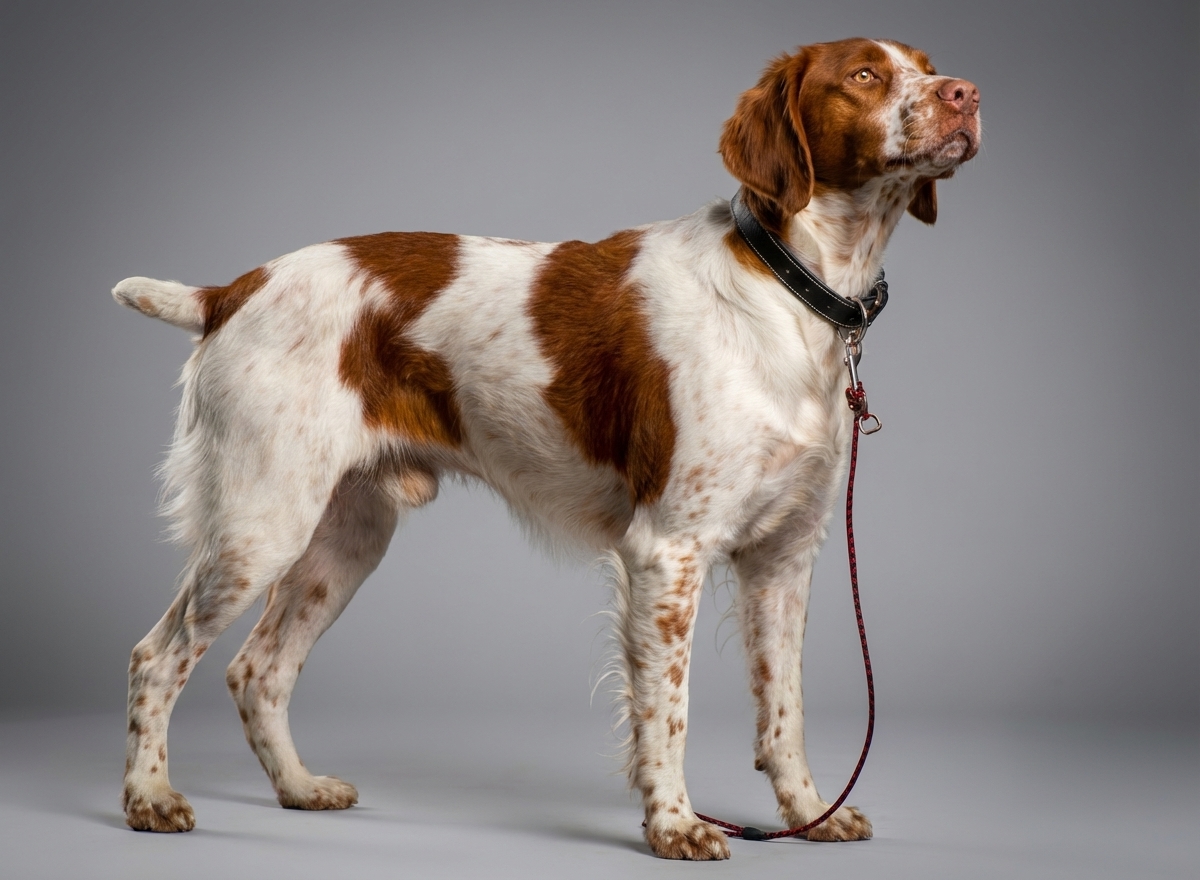
- Typical life span
- 12-15 years
- Size
- Medium — from its typical weight
- Weight
- 14-18 kg
- Height
- 44-52 cm
- FCI status
- Recognised by FCI
- FCI group
- Pointing Dogs
- Origin
- France
- Also called
- Spaniel Breton
- Known hereditary risks
- 2 documented conditions, with the test for each
About
What is a Brittany Spaniel?
Medium-sized, compact and leggy sporting dog with an athletic build and distinctive orange and white feathered coat. Known for its versatility in pointing and retrieving, this agile gundog combines high energy for hunting and field work with an intelligent and happy-go-lucky disposition.
Brittany Spaniel history and origins
Developed in the 17th-18th century in the Brittany province of France as a versatile hunting dog capable of pointing and retrieving on various terrain. Refined through crosses with English Setters and recognized by AKC in 1934.
Brittany Spaniel appearance and size
Typically 14-18 kg and 44-52 cm at the shoulder — published as one range rather than separately for males and females.
What the breed standard says
- Bred for
- Pointing dogs
- Behaviour and temperament
“Dog adapting itself to any environment, sociable, with an intelligent and attentive expression, mentally balanced. Versatile pointing dog, for any game on any terrain, precocious in revealing its hunting passion. Remarkable in its searching for game, its gaits, its scenting ability, its ranging in the field, its spontaneity and duration of pointing, its retrieving and its aptitude for training”
Quoted from FCI standard n°95. It describes the breed the registry recognises, not any individual animal.
Breed reference from The Dog API.
Characteristics
- Size
- Medium
- Exercise needsRead from what the breed was bred to do, in the registry’s own words: “Pointing dogs” That is a working purpose, not a measured exercise requirement — an individual dog’s needs depend on its age, health and household.
- 4 of 5
- Easy to train
- —
- Amount of shedding
- —
- Grooming needs
- 4 of 5
- Good with children
- —
- Cost to keep
- —
- Tolerates being alone
- —
- Intelligence
- —
- Health of breed
- 2 conditions documented
Pros & cons
Pros & cons for the Brittany Spaniel
What you get with the Brittany Spaniel
- Purpose stated in the standard: “Pointing dogs”
- The standard describes the breed as: “Dog adapting itself to any environment, sociable, with an intelligent and attentive expression, mentally balanced”
What you are taking on
- 2 serious inherited conditions are documented, mainly in bones & joints and brain & nerves. The health guide tab has the test to ask for on each.
- High grooming needs — the standard’s own description is “The hind part of the latter has a heavier coat, furnished with abundant feathering,…”
Drawn from sources rather than written as an opinion — cited health research, the registry’s own standard, and peer-reviewed longevity. FCI breed standard; OFA / CHIC Program, Brittany. One breeder’s animals can differ from any of it, and an empty column means we hold nothing for that side rather than that there is nothing to say.
Characteristics
FCI standard · Brittany Spaniel
Coat and colour
As the FCI standard sets it out. Every line below is the standard’s own wording, tagged preferred and permissible.
Coat
The coat is fine but not silky, lying flat on the body or with a hint of a wave.
Never curly.
Short on the head and the front of the limbs.
The hind part of the latter has a heavier coat, furnished with abundant feathering, diminishing along their length down to the carpus (wrist) or the tarsus (hock), or even lower
Colour
- Preferred
- Permissible
- Undesirable
- Disqualifying
Preferred, permissible, undesirable and disqualifying are FCI’s own words about the breed. They describe what the standard asks for — not an assessment of any individual dog, and not ours.
Shortened from FCI standard n°95 — each label is the standard’s own wording with the verdict lifted into the tag beside it. Read the full clause at source.
What the breed standard says
- Size
- “Heitght at the withers: Males: 48 cm minimum (18,9’’) with a tolerance of 1 cm (0,4’’). 51 cm maximum (20,1’’) with a tolerance of 1 cm (0,4’’). Ideal height: 49 to 50 cm (19,3’’ to 19,7’’). Females:47 cm minimum (18,5’’) with a tolerance of 1 cm (0,4’’). 50 cm maximum (20,1’’) with a tolerance of 1 cm (0,4’’). Ideal height: 48 to 49 cm (18,9’’ to 19,3’’)”
- FCI gives a bound on one side only, so there is no range to state.
Quoted from FCI standard n°95. It describes the breed the registry recognises, not any individual animal.
What the standard penalises
What a judge marks the Brittany Spaniel down for, and what puts one out of the ring, in the registry’s own words. This describes the breed standard — it is not a checklist for the animal in front of you, and a pet with a disqualifying fault is an unshowable dog rather than an unhealthy one.
Severe faults
Marked heavily against a specimen in the ring.
- Behaviour: Sluggish.
- Skull: Zygomatic arches too prominent, stop very pronounced, superciliary arches too prominent.
- Eyes: Light, mean look, haw-like expression.
- Neck: Excessively long, distinct dewlap.
- Gait: Poor mover
Disqualifying faults
Puts an animal out of the ring altogether.
- Lack of type: Insufficient breed characteristics, which means the animal on the whole doesn’t resemble other samples of the breed.
- Height: Outside the limits defined by the standard.
- Head planes: Marked convergence.
- Abnormal markings: White spot on the ear or eye in a white patch.
- Eyes: Very light in colour, heterochromia (eyes of different colours), squinting entropion, ectropion.
- Jaws/Teeth: Overshot or undershot mouth. The first premolars of both jaws and the last molars of the lower jaw are considered without importance. Can only be admitted the absence of 2 PM2 or 1 PM2 and 1 PM3. Contiguous absence of these two teeth (PM2 and PM3) is eliminating. Absence of any other tooth is eliminating.
- Pigmentation: Distinct unpigmented areas on the nose or eyelids.
- Presence of dewclaws, even if rudimentary.
- Serious morphological anomaly
Breed-level information from The Dog API. It describes the Brittany Spaniel in general; any individual animal can differ.
Health guide
Health & screening guide for the Brittany Spaniel
Known hereditary risks for the Brittany Spaniel breed, and the specific documentation to request from any breeder before paying a deposit. A responsible breeder will have these readily available; deflection is a red flag.
2 conditions documentedThis is breed-level literature, not veterinary advice about an individual animal — your vet knows the animal.
Health checklist (PDF)Bones & joints
Hip dysplasia
Serious
Malformation of the hip joint leading to wear, arthritis and pain over time. A required (not elective) test in this breed's CHIC protocol.
What to ask for
An OFA (or PennHIP) hip evaluation on both parents
Brain & nerves
Hereditary canine spinal muscular atrophy
Serious
A progressive, inherited degeneration of the spinal cord's motor neurons causing muscle wasting and weakness. This is genuinely breed-specific and has been studied since the late 1970s, but no causal gene has been identified even now, so there is no DNA test.
What to ask for
No DNA test exists. Ask the breeder directly whether progressive hind-limb weakness, muscle wasting or a diagnosis of motor neuron disease has occurred in the sire, dam, or their close relatives; inheritance is autosomal dominant, so an affected close relative is meaningful
How long the Brittany Spaniel lives, in the records
Median survival 11,1 years
95% confidence interval 10,9–11,3 years, from 734 recorded deaths among 965 dogs
Mortality hazard 1.49 (1.38, 1.6) relative to crossbred dogs, whose median is 12,0 years.
Measured in the United Kingdom from 584.734 dogs. Median survival is not a prediction for an individual dog.
McMillan, K.M., Bielby, J., Williams, C.L., Upjohn, M.M., Casey, R.A. & Christley, R.M. (2024) Longevity of companion dog breeds: those at risk from early death. Scientific Reports 14, 531.
Gallery
No photographs yet
This is where Brittany Spaniel owners’ own photographs will go, from the pet profiles they keep here. Nobody has added one to a public page yet.
A photograph in a pet profile stays private to its owner. We will not put one here unless they ask us to.
Puppies
No puppies listed right now
No Brittany Spaniel breeder has a record on this platform yet, so there is nothing to list. That is a gap in our coverage, not a fact about the breed.