
Skip to content

About the Beagle

Origin: Great Britain
Typical life span
10-15 years
Size
Medium — from its typical weight
Weight
9-14 kg
Height
Male
33-41 cm
Female
33-38 cm
FCI status
Recognised by FCI
FCI group
Scent hounds and related breeds
Origin
Great Britain

About

What is a Beagle?

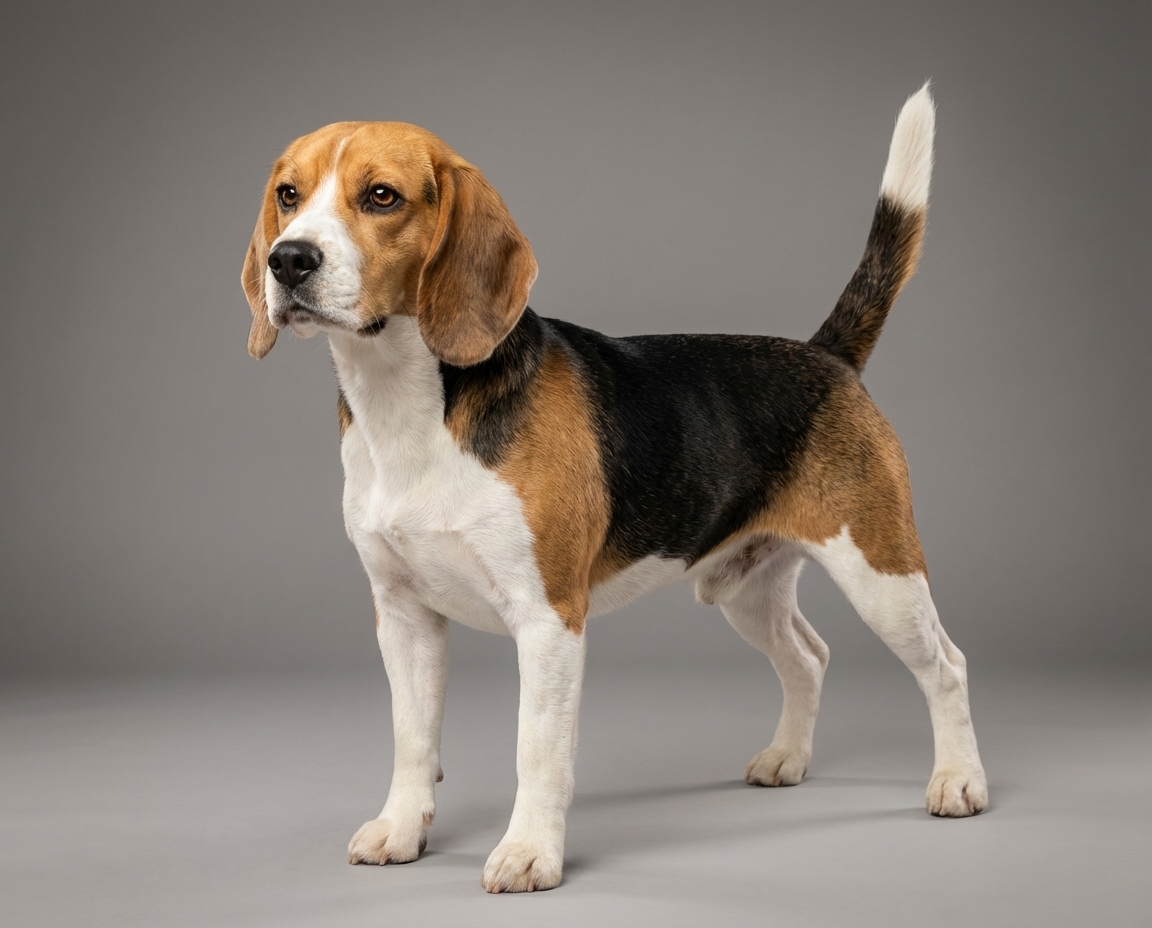
Compact, merry scent hound with sturdy build, distinctive tri-color or bi-color coat pattern, and cheerful disposition. Originally bred for hunting hare in packs with a distinctive baying voice.

Beagle history and origins

The modern Beagle was developed in Great Britain around the 1830s from various English hounds. Bred as 'foot hounds' for hare hunting, with hunters following on foot rather than horseback.

Beagle appearance and size

Males typically stand 33-41 cm at the shoulder and females 33-38 cm.

What the breed standard says

Bred for
Scent Hound
Behaviour and temperament
A merry hound whose essential function is to hunt, primarily hare, by following a scent. Bold, with great activity, stamina and determination. Alert, intelligent and of even temperament. Amiable and alert, showing no aggression or timidity

Quoted from FCI standard n°161. It describes the breed the registry recognises, not any individual animal.

Breed reference from The Dog API.

Characteristics

Size
Medium
Exercise needs
4 of 5
Easy to train
Amount of shedding
Grooming needs
2 of 5
Good with children
Cost to keep
Tolerates being alone
Intelligence

Pros & cons

Pros & cons for the Beagle

What you get with the Beagle

  • Purpose stated in the standard: “Scent Hound”
  • The standard describes the breed as: “A merry hound whose essential function is to hunt, primarily hare, by following a scent”
  • Low grooming needs, fitting for a busy owner — the coat is “Short, dense and weatherproof”

What you are taking on

  • 3 serious inherited conditions are documented, mainly in bones & joints and eyes. The health guide tab has the test to ask for on each.

Drawn from sources rather than written as an opinion — cited health research, the registry’s own standard, and peer-reviewed longevity. FCI breed standard; PubMed / An ADAMTSL2 founder mutation causes Musladin-Lueke Syndrome, a heritable disorder of beagle dogs. One breeder’s animals can differ from any of it, and an empty column means we hold nothing for that side rather than that there is nothing to say.

Characteristics

FCI standard · Beagle

Coat and colour

As the FCI standard sets it out. Every line below is the standard’s own wording, tagged permissible.

Coat

Short, dense and weatherproof

Colour

  • Preferred
  • Permissible
  • Undesirable
  • Disqualifying

Preferred, permissible, undesirable and disqualifying are FCI’s own words about the breed. They describe what the standard asks for — not an assessment of any individual dog, and not ours.

Base colour

Tricolour (black, tan and white)

  • blue, white and tan
  • badger pied
  • hare pied
  • lemon pied
  • lemon and white
  • red and white
  • tan and white
  • black and white
  • all white.
  • With the exception of all white, all the above mentioned colours can be found as mottle.
  • Permissible: No other colours
  • Tip of stern white

Shortened from FCI standard n°161 — each label is the standard’s own wording with the verdict lifted into the tag beside it. Read the full clause at source.

What the breed standard says

Size
Desirable minimum height at the withers 33 cms. Desirable maximum height at the withers 40 cms
FCI gives a bound on one side only, so there is no range to state.

Quoted from FCI standard n°161. It describes the breed the registry recognises, not any individual animal.

Breed-level information from The Dog API. It describes the Beagle in general; any individual animal can differ.

Health guide

Health & screening guide for the Beagle

Known hereditary risks for the Beagle breed, and the specific documentation to request from any breeder before paying a deposit. A responsible breeder will have these readily available; deflection is a red flag.

4 conditions documented

Health checklist (PDF)

Bones & joints

Chondrodystrophy-linked intervertebral disc disease (IVDD)

Serious

A raised risk of premature disc degeneration from the same FGF4 retrogene insertion (CDDY) implicated in Dachshunds; testing-lab data show it at very high frequency in Beagles (allele frequency around 95%), and referral case series list Beagles among the breeds commonly presenting with IVDD.

What to ask for

A CDDY/IVDD-risk DNA test on both parents

2 sources

Eyes

Primary open-angle glaucoma

Serious

A build-up of pressure inside the eye that progressively and irreversibly damages the optic nerve, leading to blindness. Documented in the Beagle via mutations in ADAMTS10, alongside the Norwegian Elkhound.

What to ask for

A DNA test for the ADAMTS10 mutation on both parents, plus a current ACVO eye exam

1 source

Blood

Other

How long the Beagle lives, in the records

Median survival 12,5 years

95% confidence interval 12,3–12,7 years, from 1552 recorded deaths among 4664 dogs

Mortality hazard 0.95 (0.91, 1) relative to crossbred dogs, whose median is 12,0 years.

Measured in the United Kingdom from 584.734 dogs. Median survival is not a prediction for an individual dog.

McMillan, K.M., Bielby, J., Williams, C.L., Upjohn, M.M., Casey, R.A. & Christley, R.M. (2024) Longevity of companion dog breeds: those at risk from early death. Scientific Reports 14, 531.

Puppies

No puppies listed right now

No Beagle breeder has a record on this platform yet, so there is nothing to list. That is a gap in our coverage, not a fact about the breed.

Sections