Base colour
Generally black, white and tan (tri-colour)
- lemon and white (bi-colour)
- Any recognized hound colour acceptable
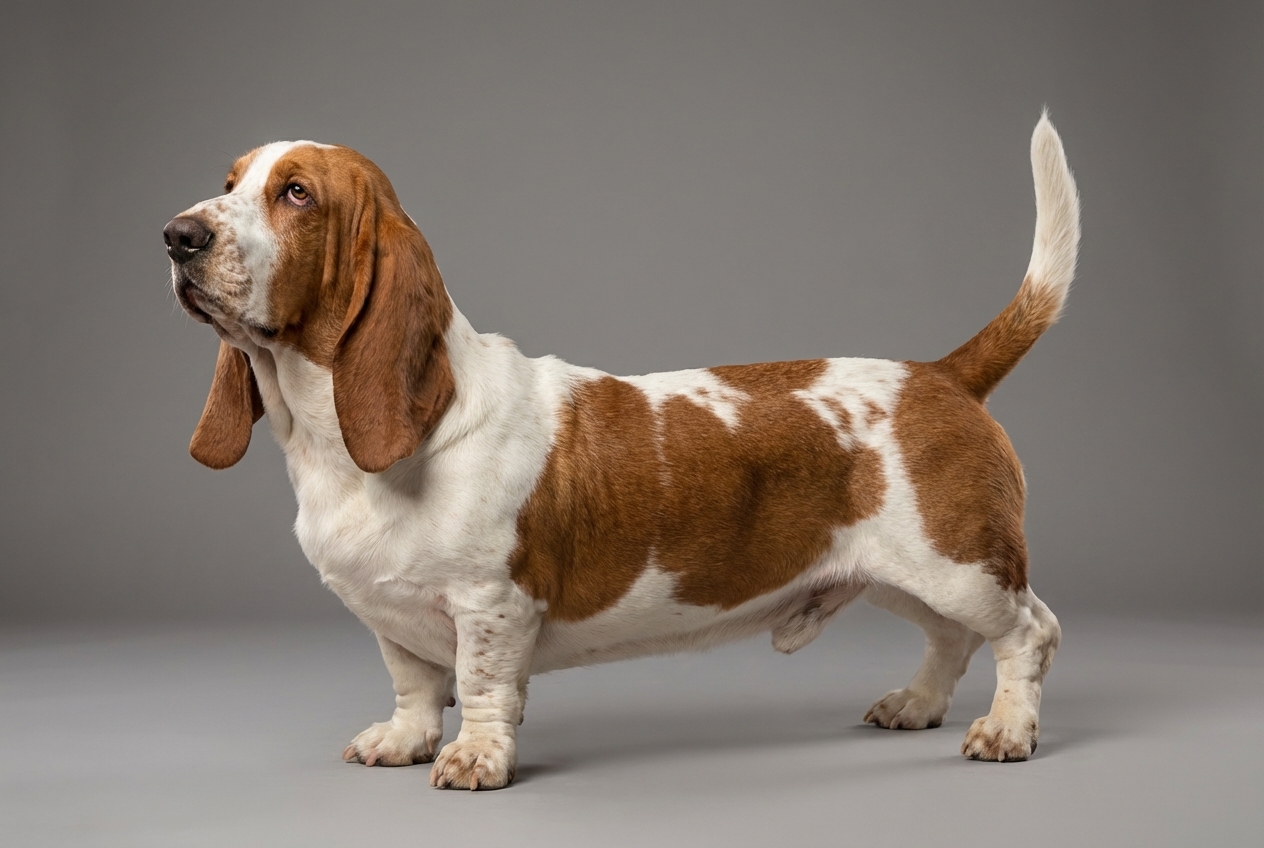
Low-slung, heavy-boned scent hound with distinctive long, velvety ears, mournful expression, and loose skin. Known for powerful tracking ability and calm demeanor.
Developed by French aristocrats from hounds bred at the Abbey of St. Hubert for hunting small game in dense cover. Low-slung body perfected for trailing rabbits and hare, later refined in England for pack hunting.
Typically 18-30 kg and 33-38 cm at the shoulder — published as one range rather than separately for males and females.
“Tenacious hound of ancient lineage which hunts by scent, possesses a pack instinct and a timid. deep melodious voice. Placid, never aggressive or Affectionate”
Quoted from FCI standard n°163. It describes the breed the registry recognises, not any individual animal.
Breed reference from The Dog API.
Drawn from sources rather than written as an opinion — cited health research, the registry’s own standard, and peer-reviewed longevity. FCI breed standard; UFAW / Dachshund: Intervertebral Disc Disease (names Basset Hound as a chondrodystrophic breed at elevated IVDD risk). One breeder’s animals can differ from any of it, and an empty column means we hold nothing for that side rather than that there is nothing to say.
FCI standard · Basset Hound
As the FCI standard sets it out. Every line below is the standard’s own wording.
Smooth, short and close without being too fine.
Whole outline clean and free from feathering.
Long hair, soft coat or feathering highly undesirable
Preferred, permissible, undesirable and disqualifying are FCI’s own words about the breed. They describe what the standard asks for — not an assessment of any individual dog, and not ours.
Base colour
Generally black, white and tan (tri-colour)
Shortened from FCI standard n°163 — each label is the standard’s own wording with the verdict lifted into the tag beside it. Read the full clause at source.
Breed-level information from The Dog API. It describes the Basset Hound in general; any individual animal can differ.
Known hereditary risks for the Basset Hound breed, and the specific documentation to request from any breeder before paying a deposit. A responsible breeder will have these readily available; deflection is a red flag.
4 conditions documentedThis is breed-level literature, not veterinary advice about an individual animal — your vet knows the animal.
Health checklist (PDF)The same class of FGF4 skeletal mutation that gives the Basset Hound its short legs and long back also predisposes it, like the Dachshund, to premature disc degeneration and herniation, which can cause severe pain or paralysis.
What to ask for
A CDDY/IVDD-risk DNA test on both parents, or a radiographic disc-calcification assessment
A build-up of pressure inside the eye that progressively and irreversibly damages the optic nerve, leading to blindness. Caused by either of two independent mutations in ADAMTS17 identified specifically in the Basset Hound and the Basset Fauve de Bretagne.
What to ask for
A DNA test for the ADAMTS17 mutations on both parents, plus a current ACVO eye exam
An inherited platelet function disorder in which platelets fail to aggregate normally, causing prolonged bleeding after injury or surgery, such as oral bleeding from a cracked tooth; typically a mild-to-moderate bleeding tendency rather than spontaneous haemorrhage.
What to ask for
No OFA-registered DNA test could be confirmed; ask the breeder for documented normal clotting/platelet function screening in the sire and dam, or a specialist laboratory diagnosis clearing close relatives
The stomach fills with gas and twists on itself, cutting off its own blood supply; without emergency surgery it is fatal within hours. The Basset Hound is one of the deep-chested breeds named at elevated risk, and a first-degree relative's history of the condition raises an individual dog's own risk.
What to ask for
No DNA test exists. Ask whether the sire or dam has had a prophylactic gastropexy, and whether gastric dilatation-volvulus has occurred in the litter's close relatives
Median survival 12,5 years
95% confidence interval 12,2–12,7 years, from 883 recorded deaths among 1997 dogs
Mortality hazard 0.9 (0.84, 0.96) relative to crossbred dogs, whose median is 12,0 years.
Measured in the United Kingdom from 584.734 dogs. Median survival is not a prediction for an individual dog.
McMillan, K.M., Bielby, J., Williams, C.L., Upjohn, M.M., Casey, R.A. & Christley, R.M. (2024) Longevity of companion dog breeds: those at risk from early death. Scientific Reports 14, 531.
This is where Basset Hound owners’ own photographs will go, from the pet profiles they keep here. Nobody has added one to a public page yet.
A photograph in a pet profile stays private to its owner. We will not put one here unless they ask us to.
No Basset Hound breeder has a record on this platform yet, so there is nothing to list. That is a gap in our coverage, not a fact about the breed.