

- More than 80% white, black and tan, and liver not to be encouraged
Permissible
- Any colour, solid, particolour, or patched
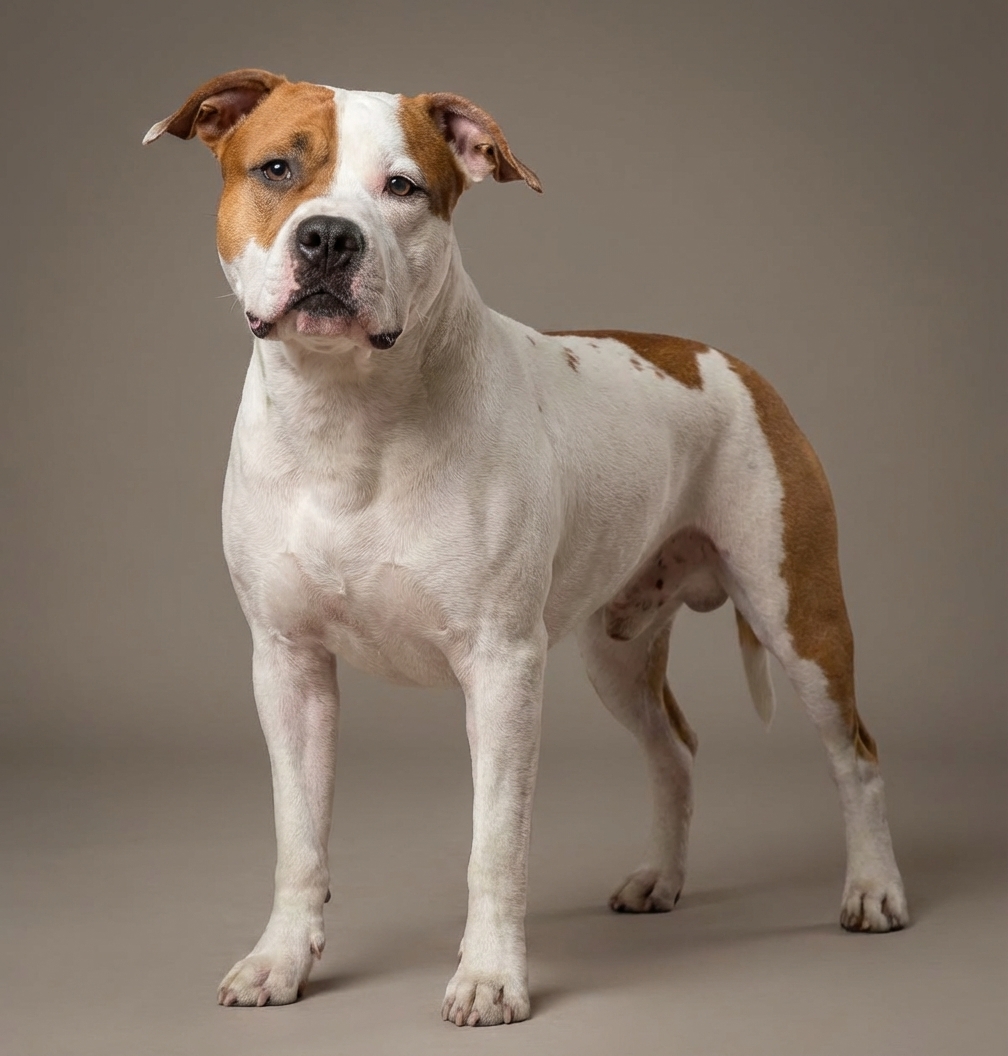
The American Staffordshire Terrier is on the legal list. To keep one you need:
At handover the law asks for that licence. Without a stud-book (LOP) registration, the dog must be neutered between 4 and 6 months. In public, a muzzle and a lead of up to 1 m. Source (the law, opens in a new tab)
The American Staffordshire Terrier is on Spain's legal list. You need a municipal licence before you buy one. To get it:
Then registration in the municipal register within 15 days. In public, a muzzle and a lead under 2 m. The autonomous community may add rules. Source (the law, opens in a new tab)
A muscular, stocky, but agile medium-sized terrier of remarkable strength with a broad head, strong build, smooth coat and confident, good-natured personality
Developed in the 19th century from crosses of bulldogs and terriers brought to America in the 1800s. Originally bred for bull-baiting and pit fighting, later refined to be larger than English Staffordshire Bull Terriers and developed into all-purpose farm dogs and family companions. Recognized by the AKC in 1936.
Generally described as confident, courageous, loyal, intelligent e smart.
That is the breed in general, not a promise about one animal. Ask the breeder what their own line is like, and meet the parents before you decide.
Breed reference from The Dog API.
Drawn from sources, not opinion: FCI breed standard; The Dog API; Staffordshire Terrier Club of America — Health. An empty column means we hold nothing for that side, not that there is nothing to say.
The American Staffordshire Terrier standard is published by the FCI (Fédération Cynologique Internationale), the international federation of pedigree-dog clubs, and it is what show judges apply. This section sums up what it says about coat and colour. It does not assess any one animal: use it to know what to ask the breeder.
Permissible
Shortened from FCI standard n°286 — each label is the standard’s own wording with the verdict lifted into the tag beside it. Read the full clause at source.
The colours and patterns the standard admits, and what it prefers, discourages or disqualifies in each. An accepted colour says nothing about health. Quotations from the FCI are in English, as the standard publishes them; the headings are ours.
Breed-level information from The Dog API. It describes the American Staffordshire Terrier in general; any individual animal can differ.
Known hereditary risks for the American Staffordshire Terrier breed, and the specific documentation to request from any breeder before paying a deposit. A responsible breeder will have these readily available; deflection is a red flag.
2 conditions documentedThis is breed-level literature, not veterinary advice about an individual animal — your vet knows the animal.
Health checklist (PDF)Found in more than about one in twenty of the breed's dogs screened, or described as common in the sources.
A late-onset, incurable neurodegenerative disease (ARSG gene) causing cerebellar signs — incoordination, tremor, abnormal gait — that usually appear between 3 and 6 years old and progress until the dog is euthanised. Puppies are unaffected and look completely normal at the time of sale. It is recessive. In a screen of 42,746 American Staffordshire Terriers roughly one in fifteen carried the variant, and roughly one in 850 would be expected to have two copies.
What to ask for
DNA test result for NCL-A (ARSG gene) on both parents, registered with the OFA; required for a CHIC number under the Staffordshire Terrier Club of America's health programme.
Documented in this breed, but no source says how many of its dogs carry or have them. That is a gap in the evidence, not a sign they are rare.
An inherited neuromuscular disease causing progressive laryngeal paralysis and polyneuropathy — weakness, exercise intolerance and noisy or laboured breathing — beginning in young dogs. A 2025 study by a team including University of Missouri researchers, so far only a preprint that has not been peer reviewed, linked it to a variant in the PAOX gene that appears to be recessive: 51 of 53 affected American Staffordshire Terriers carried two copies, and it was not found in 2,519 dogs of other breeds.
What to ask for
DNA test result for ALPP on both parents, registered with the OFA; required for the same CHIC number as NCL-A.
Median survival 12,5 years
95% confidence interval 11,4–13,1 years, from 94 recorded deaths among 134 dogs
Mortality hazard 1.09 (0.89, 1.33) relative to crossbred dogs, whose median is 12,0 years.
Measured in the United Kingdom from 584.734 dogs. Median survival is not a prediction for an individual dog.
McMillan, K.M., Bielby, J., Williams, C.L., Upjohn, M.M., Casey, R.A. & Christley, R.M. (2024) Longevity of companion dog breeds: those at risk from early death. Scientific Reports 14, 531.