- Permissible: All colour varieties and patterns including all colour varieties with white
- Permissible: Any amount of white
About the Manx
Origin: Isle of Man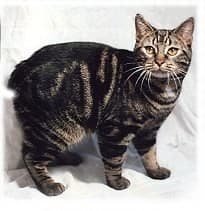
View Manx breedersSee Manx kittens
Todavía no hay ningún criador en el registro aquí. El club portugués miembro de la FIFe no lista esta raza en su directorio de criadores, así que una ausencia aquí no dice nada sobre si alguien la cría en Portugal.
- Typical life span
- 12-14 years
- Size
- Medium — from its typical weight
- Weight
- 3.6-5.9 kg
- Height
- 25-30 cm
- Registry status
- Reconocida por la TICA
- Breed group
- Short/Long-hair
- Origin
- Isle of Man
- Known hereditary risks
- 1 documented condition, with the test for each
About
What is a Manx?
Medium-sized, compact cat with round body and no tail or partial tail. Powerful hindquarters give rabbit-like hopping gait.
Manx history and origins
Ancient breed from the Isle of Man where taillessness developed through isolated island genetics. Taillessness caused by dominant gene. Various tail lengths occur - rumpy (no tail) to longy (full tail).
Manx appearance and size
Typically 3.6-5.9 kg and 25-30 cm at the shoulder — published as one range rather than separately for males and females.
Manx temperament and personality
Generally described as easy going, intelligent, loyal, playful, social, gentle and affectionate.
That is the breed in general, not a promise about one animal. Ask the breeder what their own line is like, and meet the parents before you decide.
Referencia de la raza de The Cat API.
Características
- Tamaño
- Medium
- Necesidad de ejercicio
- —
- Facilidad de adiestramiento
- —
- Caída de pelo
- 3 of 5
- Cuidados del pelo
- 2 of 5
- Convivencia con niños
- —
- Coste de mantenimiento
- —
- Tolera quedarse solo
- —
- Inteligencia
- —
- Salud de la raza
- 1 condition documented
Pros & cons
Pros y contras de la raza Manx
Lo que obtienes con la raza Manx
- Exige pocos cuidados del pelo, adecuado para quien tiene poco tiempo — el pelo es «Double, short and glossy coat»
- Descrito habitualmente como: «Easy Going, Intelligent, Loyal, Playful»
Lo que asumes
- Está documentada una enfermedad hereditaria grave, en huesos y articulaciones. La pestaña de la guía de salud tiene la prueba que hay que pedir al criador.
Extraído de fuentes y no escrito como opinión — investigación de salud citada, el estándar del propio registro, y estudios de longevidad revisados por pares. Estándar de la raza, FIFe; The Cat API; Vetlexicon Felis — Sacrocaudal dysgenesis of Manx cats. Los animales de un criador pueden diferir de todo esto, y una columna vacía significa que no tenemos nada de ese lado, no que no haya nada que decir.
Characteristics
Estándar de la FIFe · Manx
Pelo y color
Tal como lo establece el estándar de la FIFe. Cada línea de abajo está en las palabras del propio estándar, etiquetada con permissible.
Coat
Double, short and glossy coat.
The undercoat is softer than the dense and springy overcoat.
Color
- Preferred
- Permissible
- Undesirable
- Disqualifying
«Preferred», «permissible», «undesirable» y «disqualifying» — preferido, admisible, indeseable y descalificante — son las palabras de la propia FIFe sobre la raza, y quedan en inglés porque así constan en el estándar. Describen lo que el estándar pide — no son una valoración de ningún perro concreto, ni nuestra.
Resumido de FIFe standard MAN — cada etiqueta está en las palabras del propio estándar, con el veredicto pasado a la etiqueta de al lado. Lee la cláusula completa en la fuente.
TICA divisions
TICA lists the Manx in these divisions. They are the registry's own groupings — usually hair length — not a list of colours: no registry we hold publishes one. Ask a breeder what colours their line produces.
- Tailed
Temperamento
Easy GoingIntelligentLoyalPlayfulSocialGentleAffectionate
Información a nivel de raza, de The Cat API. Describe la raza Manx en general; cualquier animal concreto puede ser distinto.
Health guide
Health & screening guide for the Manx
Riesgos hereditarios conocidos en la raza Manx, y la documentación concreta que hay que pedir a cualquier criador antes de pagar una señal. Un criador responsable tiene esta documentación a mano; esquivar la pregunta es mala señal.
1 enfermedad documentadaEsto es literatura a nivel de raza, no asesoramiento veterinario sobre un animal concreto — tu veterinario conoce al animal.
Health checklist (PDF)Bones & joints
Sacrocaudal dysgenesis ("Manx syndrome")
SeriousInherente a la raza
The same dominant gene that shortens or removes the tail can also disrupt development of the lowest spinal segments and the nerves supplying the hind legs, bladder and bowel. Effects range from none at all to hind-limb weakness, a hopping gait and incontinence, and can include spina bifida. Fully tailless cats ("rumpies") carry the highest risk; the more tail present, the lower the risk.
Qué pedir
There is no DNA test for the Manx tail-length gene or for Manx syndrome. Ask for a veterinary neurological and orthopaedic exam of both parents (hind-limb function, tail-stump/sacral palpation, continence) and, for any cat showing signs, spinal imaging.
Gallery
Todavía sin fotografías
Aquí es donde irán las fotografías de los propios dueños de Manx, desde los perfiles de sus animales que mantienen aquí. Nadie ha añadido ninguna a una página pública todavía.
Una fotografía en un perfil de animal queda privada de su dueño. No pondremos ninguna aquí a menos que nos lo pidan.
Kittens
No kittens listed right now
No Manx breeder has a record on this platform yet, so there is nothing to list. That is a gap in our coverage, not a fact about the breed.