
- White and orange, white and black, white and liver, with more or less extensive irregular white patches.
- Piobald or roan, sometimes with ticking on the top and sides of the muzzle or the limbs.
- Equally, in the case of tricolour coats, with tan spotting (orange to dark tan) on the top and sides of the muzzle, over the eyes, on the limbs, on the chest and over the base of the tail.
- Preferred: A narrow blaze with any colour of coat
- Permissible: A self coloured coat
About the Brittany Spaniel
Origin: France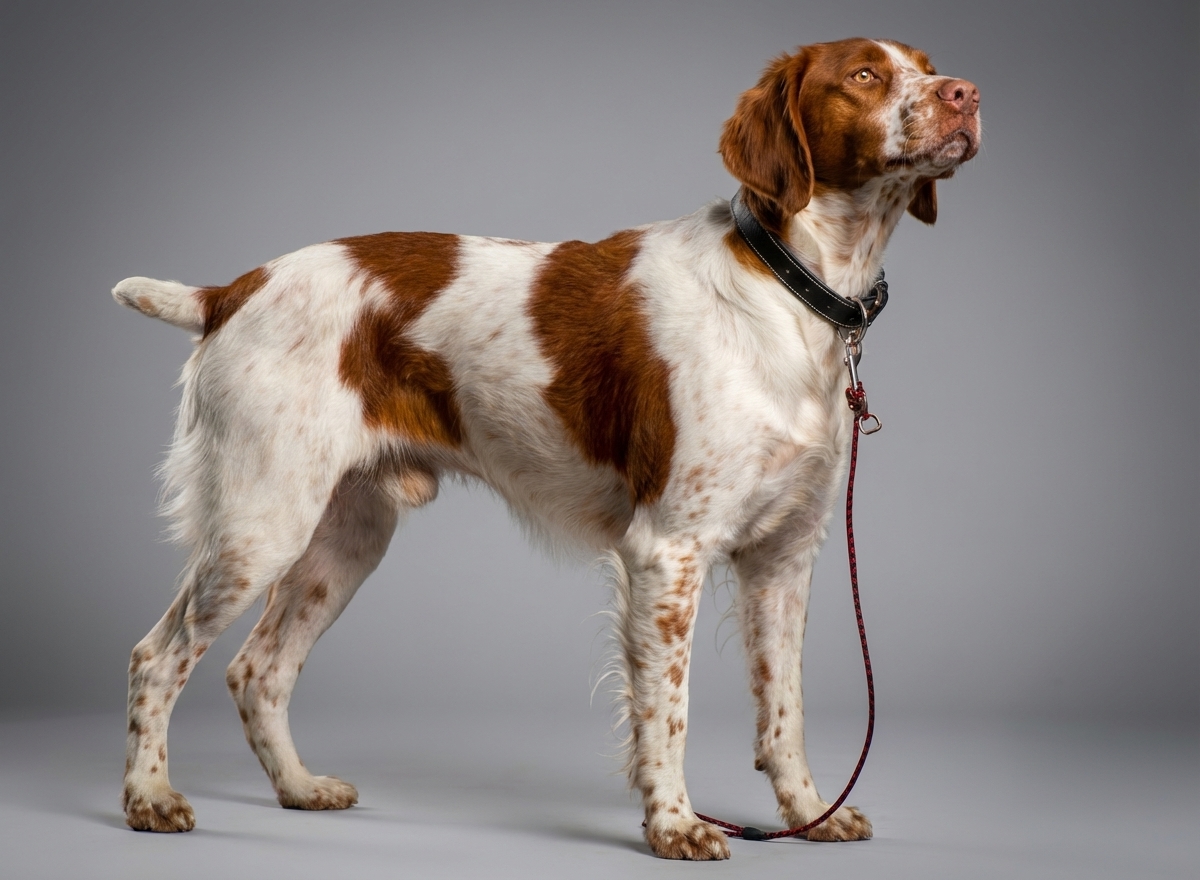
- Typical life span
- 12-15 years
- Size
- Medium — from its typical weight
- Weight
- 14-18 kg
- Height
- 44-52 cm
- FCI status
- Reconocida por la FCI
- FCI group
- Pointing Dogs
- Origin
- France
- Also called
- Spaniel Breton
- Known hereditary risks
- 2 documented conditions, with the test for each
About
What is a Brittany Spaniel?
Medium-sized, compact and leggy sporting dog with an athletic build and distinctive orange and white feathered coat. Known for its versatility in pointing and retrieving, this agile gundog combines high energy for hunting and field work with an intelligent and happy-go-lucky disposition.
Brittany Spaniel history and origins
Developed in the 17th-18th century in the Brittany province of France as a versatile hunting dog capable of pointing and retrieving on various terrain. Refined through crosses with English Setters and recognized by AKC in 1934.
Brittany Spaniel appearance and size
Typically 14-18 kg and 44-52 cm at the shoulder — published as one range rather than separately for males and females.
Lo que dice el estándar de la raza
- Criado para
- Pointing dogs
- Comportamiento y temperamento
“Dog adapting itself to any environment, sociable, with an intelligent and attentive expression, mentally balanced. Versatile pointing dog, for any game on any terrain, precocious in revealing its hunting passion. Remarkable in its searching for game, its gaits, its scenting ability, its ranging in the field, its spontaneity and duration of pointing, its retrieving and its aptitude for training”
Quoted from FCI standard n°95. It describes the breed the registry recognises, not any individual animal.
Referencia de la raza de The Dog API.
Características
- Tamaño
- Medium
- Necesidad de ejercicioLeída a partir de aquello para lo que se crió la raza, en las propias palabras del registro: “Pointing dogs” Eso es una función de trabajo, no una necesidad de ejercicio medida — las necesidades de un perro concreto dependen de su edad, su salud y su hogar.
- 4 of 5
- Facilidad de adiestramiento
- —
- Caída de pelo
- —
- Cuidados del pelo
- 4 of 5
- Convivencia con niños
- —
- Coste de mantenimiento
- —
- Tolera quedarse solo
- —
- Inteligencia
- —
- Salud de la raza
- 2 conditions documented
Pros & cons
Pros y contras de la raza Brittany Spaniel
Lo que obtienes con la raza Brittany Spaniel
- Función declarada en el estándar: «Pointing dogs»
- El estándar describe la raza así: «Dog adapting itself to any environment, sociable, with an intelligent and attentive expression, mentally balanced»
Lo que asumes
- Están documentadas 2 enfermedades hereditarias graves, sobre todo en huesos y articulaciones y cerebro y nervios. La pestaña de la guía de salud tiene la prueba que hay que pedir en cada una.
- Exige muchos cuidados del pelo — la descripción del propio estándar es «The hind part of the latter has a heavier coat, furnished with abundant feathering,…»
Extraído de fuentes y no escrito como opinión — investigación de salud citada, el estándar del propio registro, y estudios de longevidad revisados por pares. Estándar de la raza, FCI; OFA / CHIC Program, Brittany. Los animales de un criador pueden diferir de todo esto, y una columna vacía significa que no tenemos nada de ese lado, no que no haya nada que decir.
Characteristics
Estándar de la FCI · Brittany Spaniel
Pelo y color
Tal como lo establece el estándar de la FCI. Cada línea de abajo está en las palabras del propio estándar, etiquetada con preferred y permissible.
Coat
The coat is fine but not silky, lying flat on the body or with a hint of a wave.
Never curly.
Short on the head and the front of the limbs.
The hind part of the latter has a heavier coat, furnished with abundant feathering, diminishing along their length down to the carpus (wrist) or the tarsus (hock), or even lower
Color
- Preferred
- Permissible
- Undesirable
- Disqualifying
«Preferred», «permissible», «undesirable» y «disqualifying» — preferido, admisible, indeseable y descalificante — son las palabras de la propia FCI sobre la raza, y quedan en inglés porque así constan en el estándar. Describen lo que el estándar pide — no son una valoración de ningún perro concreto, ni nuestra.
Resumido de FCI standard n°95 — cada etiqueta está en las palabras del propio estándar, con el veredicto pasado a la etiqueta de al lado. Lee la cláusula completa en la fuente.
Lo que dice el estándar de la raza
- Tamaño
- “Heitght at the withers: Males: 48 cm minimum (18,9’’) with a tolerance of 1 cm (0,4’’). 51 cm maximum (20,1’’) with a tolerance of 1 cm (0,4’’). Ideal height: 49 to 50 cm (19,3’’ to 19,7’’). Females:47 cm minimum (18,5’’) with a tolerance of 1 cm (0,4’’). 50 cm maximum (20,1’’) with a tolerance of 1 cm (0,4’’). Ideal height: 48 to 49 cm (18,9’’ to 19,3’’)”
- La FCI da un límite solo por un lado, así que no hay intervalo que indicar.
Quoted from FCI standard n°95. It describes the breed the registry recognises, not any individual animal.
Lo que el estándar penaliza
Aquello por lo que un juez resta puntos a la raza Brittany Spaniel, y lo que la deja fuera del ring, en las palabras del propio registro. Esto describe el estándar de la raza — no es una lista de comprobación para el animal que tienes delante, y un animal de compañía con un defecto descalificante es un perro que no puede ir a exposición, no un perro enfermo.
Defectos graves
Cuentan mucho en contra de un ejemplar en el ring.
- Behaviour: Sluggish.
- Skull: Zygomatic arches too prominent, stop very pronounced, superciliary arches too prominent.
- Eyes: Light, mean look, haw-like expression.
- Neck: Excessively long, distinct dewlap.
- Gait: Poor mover
Defectos descalificantes
Dejan al animal fuera del ring por completo.
- Lack of type: Insufficient breed characteristics, which means the animal on the whole doesn’t resemble other samples of the breed.
- Height: Outside the limits defined by the standard.
- Head planes: Marked convergence.
- Abnormal markings: White spot on the ear or eye in a white patch.
- Eyes: Very light in colour, heterochromia (eyes of different colours), squinting entropion, ectropion.
- Jaws/Teeth: Overshot or undershot mouth. The first premolars of both jaws and the last molars of the lower jaw are considered without importance. Can only be admitted the absence of 2 PM2 or 1 PM2 and 1 PM3. Contiguous absence of these two teeth (PM2 and PM3) is eliminating. Absence of any other tooth is eliminating.
- Pigmentation: Distinct unpigmented areas on the nose or eyelids.
- Presence of dewclaws, even if rudimentary.
- Serious morphological anomaly
Información a nivel de raza, de The Dog API. Describe la raza Brittany Spaniel en general; cualquier animal concreto puede ser distinto.
Health guide
Health & screening guide for the Brittany Spaniel
Riesgos hereditarios conocidos en la raza Brittany Spaniel, y la documentación concreta que hay que pedir a cualquier criador antes de pagar una señal. Un criador responsable tiene esta documentación a mano; esquivar la pregunta es mala señal.
2 enfermedades documentadasEsto es literatura a nivel de raza, no asesoramiento veterinario sobre un animal concreto — tu veterinario conoce al animal.
Health checklist (PDF)Bones & joints
Hip dysplasia
Serious
Malformation of the hip joint leading to wear, arthritis and pain over time. A required (not elective) test in this breed's CHIC protocol.
Qué pedir
An OFA (or PennHIP) hip evaluation on both parents
Brain & nerves
Hereditary canine spinal muscular atrophy
Serious
A progressive, inherited degeneration of the spinal cord's motor neurons causing muscle wasting and weakness. This is genuinely breed-specific and has been studied since the late 1970s, but no causal gene has been identified even now, so there is no DNA test.
Qué pedir
No DNA test exists. Ask the breeder directly whether progressive hind-limb weakness, muscle wasting or a diagnosis of motor neuron disease has occurred in the sire, dam, or their close relatives; inheritance is autosomal dominant, so an affected close relative is meaningful
Cuánto vive la raza Brittany Spaniel, en los registros
Supervivencia mediana de 11,1 años
Intervalo de confianza al 95% de 10,9–11,3 años, a partir de 734 muertes registradas entre 965 perros
Riesgo de mortalidad de 1.49 (1.38, 1.6) respecto a perros mestizos, cuya mediana es de 12,0 años.
Medido en el Reino Unido a partir de 584.734 perros. La supervivencia mediana no es una predicción para un perro concreto.
McMillan, K.M., Bielby, J., Williams, C.L., Upjohn, M.M., Casey, R.A. & Christley, R.M. (2024) Longevity of companion dog breeds: those at risk from early death. Scientific Reports 14, 531.
Gallery
Todavía sin fotografías
Aquí es donde irán las fotografías de los propios dueños de Brittany Spaniel, desde los perfiles de sus animales que mantienen aquí. Nadie ha añadido ninguna a una página pública todavía.
Una fotografía en un perfil de animal queda privada de su dueño. No pondremos ninguna aquí a menos que nos lo pidan.
Puppies
No puppies listed right now
No Brittany Spaniel breeder has a record on this platform yet, so there is nothing to list. That is a gap in our coverage, not a fact about the breed.