
Saltar al contenido

About the Boxer

Origin: Germany
Typical life span
10-12 years
Size
Large — from its typical weight
Weight
Male
29-36 kg
Female
23-29 kg
Height
Male
58-64 cm
Female
55-60 cm
FCI status
Reconocida por la FCI
FCI group
Pinscher and Schnauzer - Molossoid and Swiss Mountain and Cattledogs
Origin
Germany

About

What is a Boxer?

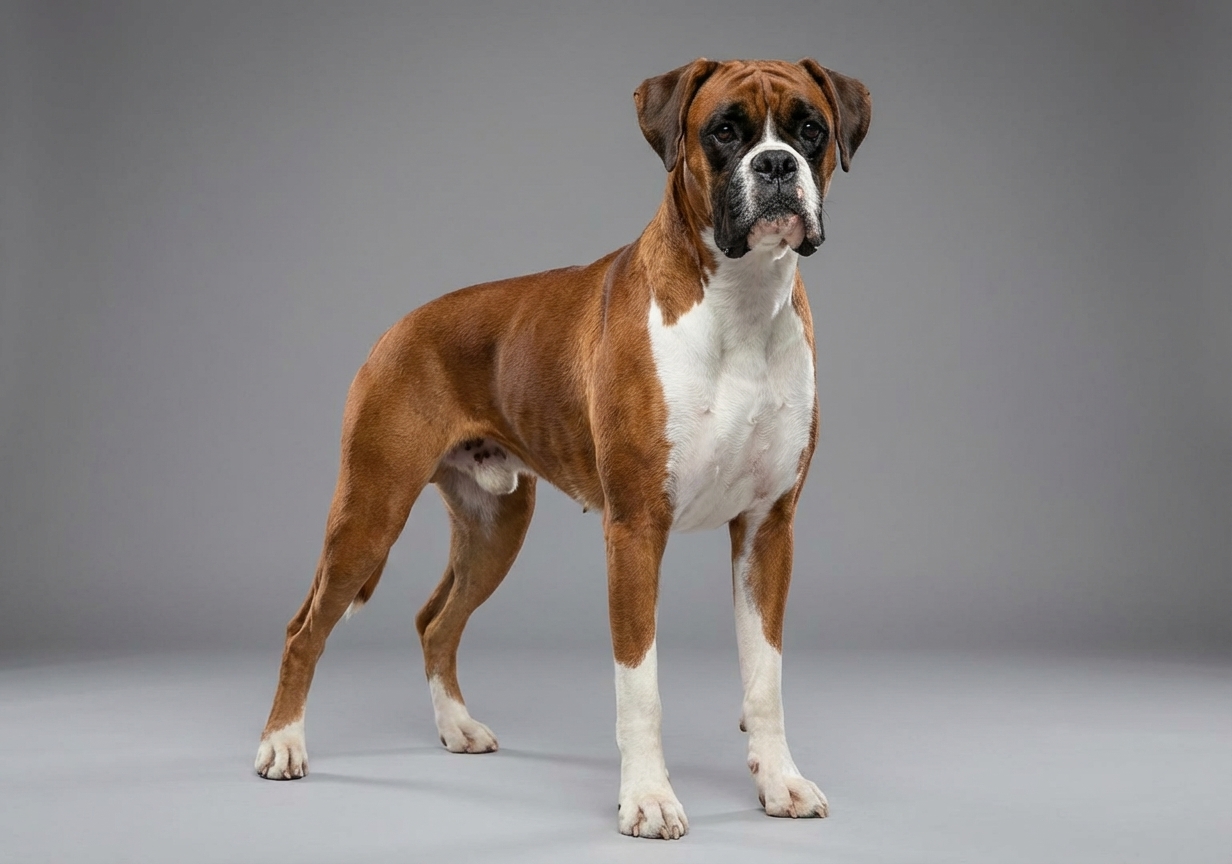
Medium to large, powerful and athletic working dog with a distinctive short-muzzled, flat face and short coat. Known for their fun-loving, bright temperament and expressive face, combining energy with loyalty.

Boxer history and origins

Developed in late 19th century Germany from the now-extinct German Bullenbeisser (used for hunting large game like boar and bear) and English Bulldog, originally for bull-baiting and hunting, later refined for working and companion roles

Boxer appearance and size

Males typically weigh 29-36 kg and stand 58-64 cm at the shoulder; females 23-29 kg and 55-60 cm.

Lo que dice el estándar de la raza

Criado para
Companion, Guard and Working Dog
Comportamiento y temperamento
The Boxer should be fearless self-confident, calm and equable. Temperament is of the utmost importance and requires careful attention. Devotion and loyalty towards his master and his entire household, his watchfulness and self-assured courage as a defender are famous. He is harmless with his family but distrustful of strangers. Happy and friendly in play, yet fearless in a serious situation. Easy to train on account of his willingness to obey, his pluck and courage, natural keenness, and scent capability. Undemanding and clean, he is just as agreeable and appreciated in the family circle as he is as a guard, companion and working dog. His character is trustworthy, with no guile or cunning, even in old age

Quoted from FCI standard n°144. It describes the breed the registry recognises, not any individual animal.

Referencia de la raza de The Dog API.

Características

Tamaño
Large
Necesidad de ejercicio
Facilidad de adiestramiento
Caída de pelo
Cuidados del pelo
2 of 5
Convivencia con niños
Coste de mantenimiento
Tolera quedarse solo
Inteligencia
Salud de la raza
7 conditions documented

Pros & cons

Pros y contras de la raza Boxer

Lo que obtienes con la raza Boxer

  • Función declarada en el estándar: «Companion, Guard and Working Dog»
  • El estándar describe la raza así: «The Boxer should be fearless self-confident, calm and equable»
  • Exige pocos cuidados del pelo, adecuado para quien tiene poco tiempo — el pelo es «Short, hard, glossy and close fitting»

Lo que asumes

  • Están documentadas 5 enfermedades hereditarias graves, sobre todo en corazón y circulación y huesos y articulaciones. La pestaña de la guía de salud tiene la prueba que hay que pedir en cada una.

Extraído de fuentes y no escrito como opinión — investigación de salud citada, el estándar del propio registro, y estudios de longevidad revisados por pares. Estándar de la raza, FCI; American Boxer Club — Health Screening Recommendations. Los animales de un criador pueden diferir de todo esto, y una columna vacía significa que no tenemos nada de ese lado, no que no haya nada que decir.

Characteristics

Estándar de la FCI · Boxer

Pelo y color

Tal como lo establece el estándar de la FCI. Cada línea de abajo está en las palabras del propio estándar.

Coat

  • Short
  • Hard
  • Glossy and close fitting

Color

  • Preferred
  • Permissible
  • Undesirable
  • Disqualifying

«Preferred», «permissible», «undesirable» y «disqualifying» — preferido, admisible, indeseable y descalificante — son las palabras de la propia FCI sobre la raza, y quedan en inglés porque así constan en el estándar. Describen lo que el estándar pide — no son una valoración de ningún perro concreto, ni nuestra.

Fawn or brindle

  • Fawn comes in various shades from light fawn to dark deer red but the most attractive shades are in the middle range (red fawn).
  • Black mask.
  • The brindle variety: fawn background of varying shades has dark or black stripes running parallel to ribs.
  • Stripes must contrast distinctly to ground colour.
  • White markings should not be discarded.
  • They can be quite pleasant

Resumido de FCI standard n°144 — cada etiqueta está en las palabras del propio estándar, con el veredicto pasado a la etiqueta de al lado. Lee la cláusula completa en la fuente.

Lo que dice el estándar de la raza

Tamaño
Height at the withers: Dogs: 57-63 cm. Females: 53-59 cm. Weight: Dogs: over 30 kg when height at withers is ca 60 cm. Bitches: about 25 kg when height at withers is ca 56 cm
La FCI da un límite solo por un lado, así que no hay intervalo que indicar.

Quoted from FCI standard n°144. It describes the breed the registry recognises, not any individual animal.

FCI varieties

FCI divides the Boxer into these varieties, listed in the registry's own words. Depending on the breed they separate colour, coat, size or line — they are not a full list of colours, which no registry we hold publishes. Ask a breeder which variety their line is.

  • FAWN
  • BRINDLE

Información a nivel de raza, de The Dog API. Describe la raza Boxer en general; cualquier animal concreto puede ser distinto.

Health guide

Health & screening guide for the Boxer

Riesgos hereditarios conocidos en la raza Boxer, y la documentación concreta que hay que pedir a cualquier criador antes de pagar una señal. Un criador responsable tiene esta documentación a mano; esquivar la pregunta es mala señal.

7 enfermedades documentadas

Health checklist (PDF)

Heart & circulation

Aortic / subaortic stenosis

Serious

A narrowing of the outflow from the heart that can range from harmless to a cause of collapse or sudden death; it can develop after a dog has already tested clear once at a younger age.

Qué pedir

Auscultation and Doppler echocardiogram by a cardiologist, on both parents, from 24 months old

1 source

Boxer cardiomyopathy (arrhythmogenic right ventricular cardiomyopathy, ARVC)

Serious

An inherited heart-rhythm disorder that can cause fainting, collapse or sudden death; the breed club's own primary screening tool is not a DNA test but an annual 24-hour Holter monitor.

Qué pedir

The club's required screen is an annual Holter monitor on breeding dogs. DNA tests exist for two known markers (striatin/ARVC1, and a second gene identified in 2021, ARVC2), but their predictive value is disputed: a negative result on either or both does not rule out the disease, since not every affected Boxer carries a known mutation, and dogs with only one copy of a mutation often stay symptom-free for years. Treat a clear DNA result as reassuring, not conclusive, alongside the Holter monitor.

3 sources

Bones & joints

Brain & nerves

Degenerative myelopathy

Serious

A progressive, incurable disease of the spinal cord causing hind-limb weakness and eventual paralysis in older dogs.

Qué pedir

Degenerative myelopathy (SOD1) DNA test, on both parents (recommended)

1 source

Immune system

Autoimmune thyroiditis

Monitor

The immune system attacks the thyroid gland, usually leading to hypothyroidism; manageable with lifelong medication once diagnosed.

Qué pedir

Full thyroid panel (TgAA, total and free T4AA, cTSH) annually while breeding

1 source

Histiocytic ulcerative colitis

Serious

A severe inflammatory bowel disease that occurs overwhelmingly in Boxers, almost always before two years old, causing bloody diarrhoea and weight loss. It responds well to antibiotic treatment once correctly diagnosed, but there is no way to predict or test for it in advance.

Qué pedir

No test exists. Ask the breeder whether they have seen it in litters from this line — it is a young-dog disease, so an experienced breeder would already know.

2 sources

Breathing

Brachycephalic airway limitation

MonitorInherente a la raza

The standard's short muzzle, pinched nostrils and short neck restrict airflow; the FCI's own judging guidance for this breed names forced breathing and snoring as a specific area of risk.

Qué pedir

No test; ask to hear the dog breathe after mild exercise in warm weather — pronounced snoring or open-mouth breathing at rest is what the FCI's own guidance flags.

1 source

Cuánto vive la raza Boxer, en los registros

Supervivencia mediana de 11,3 años

Intervalo de confianza al 95% de 11,3–11,5 años, a partir de 5925 muertes registradas entre 11.187 perros

Riesgo de mortalidad de 1.18 (1.15, 1.21) respecto a perros mestizos, cuya mediana es de 12,0 años.

Medido en el Reino Unido a partir de 584.734 perros. La supervivencia mediana no es una predicción para un perro concreto.

McMillan, K.M., Bielby, J., Williams, C.L., Upjohn, M.M., Casey, R.A. & Christley, R.M. (2024) Longevity of companion dog breeds: those at risk from early death. Scientific Reports 14, 531.

Puppies

No puppies listed right now

That is not the same as none existing. Publishing a litter is part of a breeder's subscription here, so a Boxer breeder can have a litter and no listing — ask them directly.

See Boxer breeders
Secciones