- Blue merle, black, red merle, red – all with or without white markings and/or tan markings, with no order of preference.
- The hairline of a white collar does not exceed the point of the withers at the skin.
- White is acceptable on the neck (either in part or as a full collar), chest, legs, muzzle underparts, blaze on head and white extension from underpart up to four inches (10 cm), measuring from a horizontal line at the elbow.
- White on the head should not predominate, and the eyes must be fully surrounded by colour and pigment.
- Merles characteristically become darker with increasing age
About the Australian Shepherd
Origin: United States Of America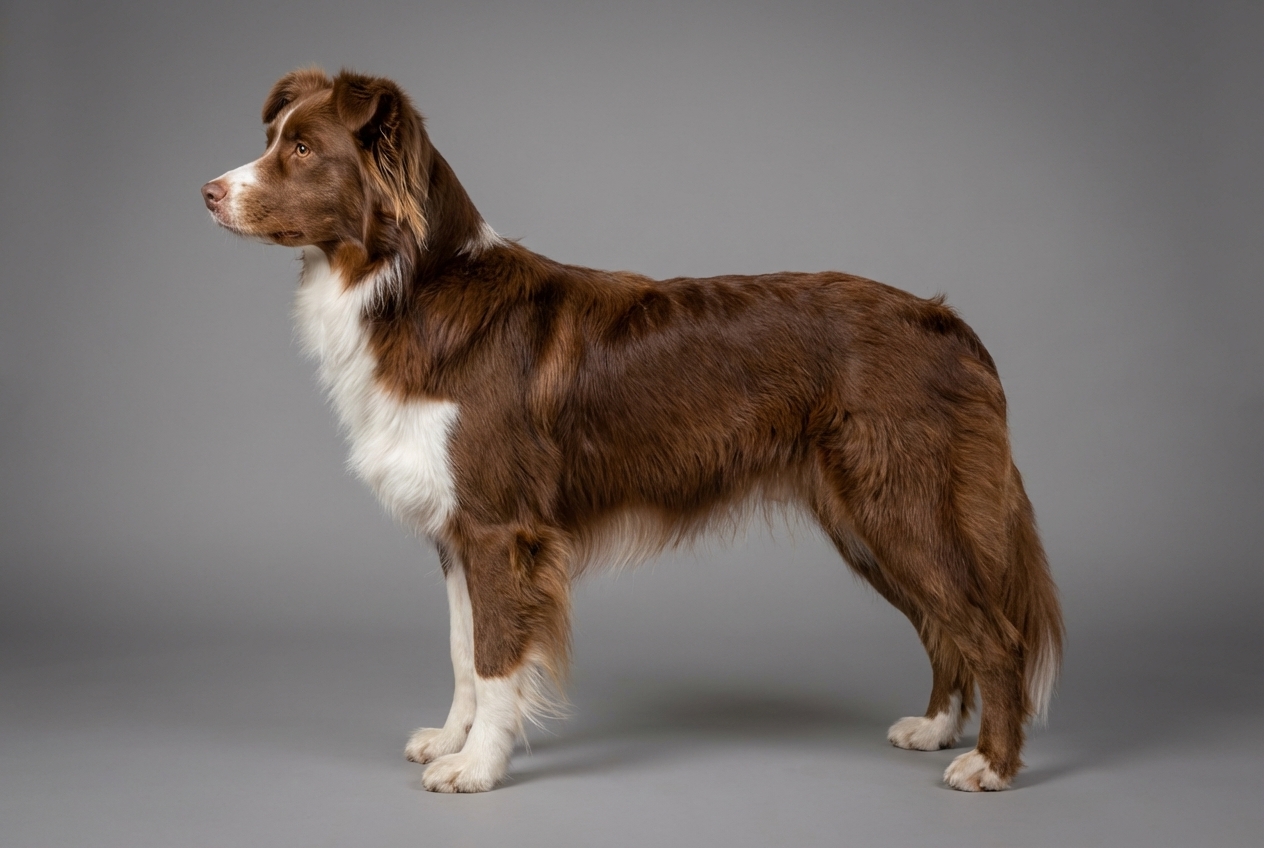
- Typical life span
- 12-15 years
- Size
- Medium — from its typical weight
- Weight
- Male
- 23-29 kg
- Female
- 18-25 kg
- Height
- Male
- 51-58 cm
- Female
- 46-53 cm
- FCI status
- Reconocida por la FCI
- FCI group
- Sheepdogs and Cattledogs (except Swiss Cattledogs)
- Origin
- United States Of America
- Also called
- Perro Pastor Australiano
- Known hereditary risks
- Not researched yet
About
What is a Australian Shepherd?
Medium-sized, agile herding dog with striking multicolored coat, expressive eyes, and keen herding instincts. Known for their intense work drive and weather-resistant double coat.
Australian Shepherd history and origins
Despite its name, the Australian Shepherd was developed in the American West in the 19th century from Basque shepherd dogs brought by immigrants from the Pyrenees region. The breed's intelligence and versatility made it popular on the rodeo circuit and for ranching work.
Australian Shepherd appearance and size
Males typically weigh 23-29 kg and stand 51-58 cm at the shoulder; females 18-25 kg and 46-53 cm.
Lo que dice el estándar de la raza
- Criado para
- Farm and ranch shepherd dog
- Comportamiento y temperamento
“The Australian Shepherd is an intelligent working dog of strong herding and guarding instincts. He is a loyal companion and has the stamina to work all day. With an even disposition, he is good natured, seldom quarrelsome. He may be somewhat reserved in initial meetings”
Quoted from FCI standard n°342. It describes the breed the registry recognises, not any individual animal.
Referencia de la raza de The Dog API.
Características
- Tamaño
- Medium
- Necesidad de ejercicioLeída a partir de aquello para lo que se crió la raza, en las propias palabras del registro: “Farm and ranch shepherd dog” Eso es una función de trabajo, no una necesidad de ejercicio medida — las necesidades de un perro concreto dependen de su edad, su salud y su hogar.
- 4 of 5
- Facilidad de adiestramiento
- —
- Caída de pelo
- 3 of 5
- Cuidados del pelo
- 4 of 5
- Convivencia con niños
- —
- Coste de mantenimiento
- —
- Tolera quedarse solo
- —
- Inteligencia
- —
- Salud de la raza
- Not researched yet
Pros & cons
Pros y contras de la raza Australian Shepherd
Lo que obtienes con la raza Australian Shepherd
- Función declarada en el estándar: «Farm and ranch shepherd dog»
- El estándar describe la raza así: «The Australian Shepherd is an intelligent working dog of strong herding and guarding instincts»
- Vive más que un perro mestizo — mediana de 13.7 años en 245 animales, frente a 12
Lo que asumes
- Exige muchos cuidados del pelo — la descripción del propio estándar es «There is a moderate mane and frill, more pronounced in dogs than in bitches»
Extraído de fuentes y no escrito como opinión — investigación de salud citada, el estándar del propio registro, y estudios de longevidad revisados por pares. Estándar de la raza, FCI; McMillan et al. 2024, median age at death. Los animales de un criador pueden diferir de todo esto, y una columna vacía significa que no tenemos nada de ese lado, no que no haya nada que decir.
Characteristics
Estándar de la FCI · Australian Shepherd
Pelo y color
Tal como lo establece el estándar de la FCI. Cada línea de abajo está en las palabras del propio estándar.
Coat
Of medium texture, straight to wavy, weather resistant and of medium length.
The undercoat varies in quantity with variations in climate.
Hair is short and smooth on the head, ears, front of forelegs and below the hocks.
Backs of forelegs and breeches are moderately feathered.
There is a moderate mane and frill, more pronounced in dogs than in bitches
Color
- Preferred
- Permissible
- Undesirable
- Disqualifying
«Preferred», «permissible», «undesirable» y «disqualifying» — preferido, admisible, indeseable y descalificante — son las palabras de la propia FCI sobre la raza, y quedan en inglés porque así constan en el estándar. Describen lo que el estándar pide — no son una valoración de ningún perro concreto, ni nuestra.
Resumido de FCI standard n°342 — cada etiqueta está en las palabras del propio estándar, con el veredicto pasado a la etiqueta de al lado. Lee la cláusula completa en la fuente.
Lo que dice el estándar de la raza
- Tamaño
- “Height at the withers: The preferred height for males is 20-23 inches (51-58 cm), females 18-21 inches (46-53 cm). Quality is not to be sacrificed in favour of size”
- La FCI distingue un ideal de lo que está permitido.
Quoted from FCI standard n°342. It describes the breed the registry recognises, not any individual animal.
Lo que el estándar penaliza
Aquello por lo que un juez resta puntos a la raza Australian Shepherd, y lo que la deja fuera del ring, en las palabras del propio registro. Esto describe el estándar de la raza — no es una lista de comprobación para el animal que tienes delante, y un animal de compañía con un defecto descalificante es un perro que no puede ir a exposición, no un perro enfermo.
Defectos graves
Cuentan mucho en contra de un ejemplar en el ring.
- Prick ears and hanging ears.
- Non-typical coats
Defectos descalificantes
Dejan al animal fuera del ring por completo.
- Undershot. Overshot by more than 1/8 inch. Loss of contact caused by short center incisors in an otherwise correct bite shall not be judged undershot. Teeth broken or missing by accident shall not be penalized.
- White body splashes in all colours, which means white on body between withers and tail, on sides between elbows and back of hindquarters
Información a nivel de raza, de The Dog API. Describe la raza Australian Shepherd en general; cualquier animal concreto puede ser distinto.
Health guide
What to ask for in a Australian Shepherd
No breed-specific health panel has been written up for the Australian Shepherd on this platform yet. That is a gap in our records, not a clean bill of health — ask the breeder which hereditary conditions their lines are tested for, and ask to see the results for both parents, dated and from a named laboratory.
Gallery
Todavía sin fotografías
Aquí es donde irán las fotografías de los propios dueños de Australian Shepherd, desde los perfiles de sus animales que mantienen aquí. Nadie ha añadido ninguna a una página pública todavía.
Una fotografía en un perfil de animal queda privada de su dueño. No pondremos ninguna aquí a menos que nos lo pidan.
Puppies
No puppies listed right now
No Australian Shepherd breeder has a record on this platform yet, so there is nothing to list. That is a gap in our coverage, not a fact about the breed.