
Permissible
- All colour varieties and patterns, including those with white
- Any amount of white
No breeder is on record here yet. Portugal’s FIFe member club does not list this breed in its breeder directory at all, so an absence here says nothing about whether anyone breeds it in Portugal.
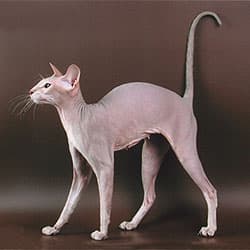
Medium-sized, elegant hairless or partially haired cat with long narrow head and large ears. Russian breed related to Oriental type.
Developed in St. Petersburg, Russia in 1994 by crossing a Don Sphynx with an Oriental Shorthair. Combines Oriental elegance with hairlessness. Can range from completely bald to short coat.
Generally described as highly intelligent, affectionate, playful, active, athletic and social.
That is the breed in general, not a promise about one animal. Ask the breeder what their own line is like, and meet the parents before you decide.
Breed reference from The Cat API.
Drawn from sources, not opinion: FIFe breed standard; The Cat API; UC Davis VGL — Progressive Retinal Atrophy (PRA rdAc). An empty column means we hold nothing for that side, not that there is nothing to say.
The Peterbald standard is published by the FIFe (Fédération Internationale Féline), the international federation of pedigree-cat clubs, and it is what show judges apply. This section sums up what it says about coat and colour. It does not assess any one animal: use it to know what to ask the breeder.
Appears hairless.
Short, soft, fine hair on the muzzle, at the base of the ears, legs and tail that feels like velvet may occur, mainly on young cats.
Permissible
Shortened from FIFe standard PEB — each label is the standard’s own wording with the verdict lifted into the tag beside it. Read the full clause at source. FIFe lists this standard’s last modification as 2024. Text read on 31 Aug 2026.
The colour varieties FIFe recognises for this breed are listed, with their EMS codes, in the table at the end of its standard. FIFe describes each colour group in the General Part of its standards.
The colours and patterns the standard admits, and what it prefers, discourages or disqualifies in each. An accepted colour says nothing about health. Quotations from the FIFe are in English, as the standard publishes them; the headings are ours.
Known hereditary risks for the Peterbald breed, and the specific documentation to request from any breeder before paying a deposit. A responsible breeder will have these readily available; deflection is a red flag.
2 conditions documentedThis is breed-level literature, not veterinary advice about an individual animal — your vet knows the animal.
Health checklist (PDF)Documented in this breed, but no source says how many of its dogs carry or have them. That is a gap in the evidence, not a sign they are rare.
Breed-level information from The Cat API. It describes the Peterbald in general; any individual animal can differ.
This inherited retinal disease causes slow, progressive vision loss and eventual blindness. It is usually marketed as an Abyssinian condition, but a large-scale genetic survey of over 11,000 cats found the same mutation at meaningful frequency in Peterbald, consistent with its Oriental Shorthair and Siamese ancestry.
What to ask for
PRA-rdAc (CEP290) DNA test result for both parents (UC Davis VGL or an equivalent laboratory)
Without a coat, skin oil that would normally be absorbed by fur instead builds up on the skin surface, and unprotected skin sunburns easily; both can lead to greasy build-up, irritation or secondary skin infections without regular bathing and sun avoidance. This follows directly from coat loss itself rather than a separate disease, so it applies to any hairless cat and is documented in detail in the genetically distinct but phenotypically similar Sphynx.
What to ask for
No DNA test applies — this follows directly from the visible coat-loss trait, not a hidden mutation. Ask the breeder about their skin-care routine (bathing frequency, sun-exposure precautions) rather than a lab document.