
- Permissible: All colours, including all colours with white
- except pointed patterns and chocolate, lilac, cinnamon and fawn.
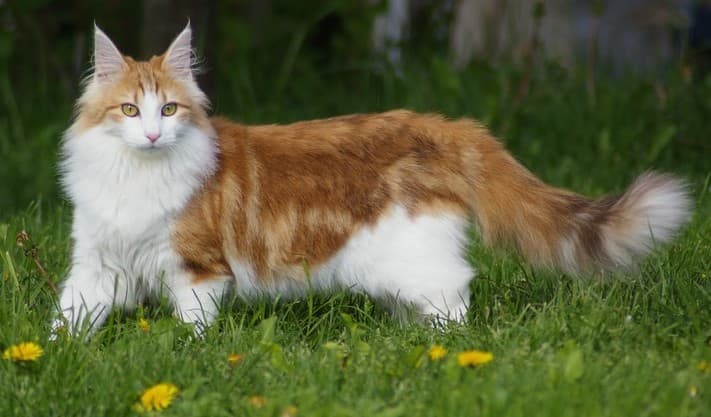
- Permissible: Any amount of white, i.e. a white blaze, white locket, white chest, white on the belly, white on the paws, etc
About the Norwegian Forest
- Registry status
- Recognised by TICA
- Known hereditary risks
- 2 documented conditions, with the test for each
Often written Norwegian Forest Cat.
About
Nothing written about this breed yet. The hereditary risks are sourced — read those.
Characteristics
- Size
- —
- Exercise needs
- —
- Easy to train
- —
- Amount of shedding
- 4 of 5
- Grooming needs
- 4 of 5
- Good with children
- —
- Cost to keep
- —
- Tolerates being alone
- —
- Intelligence
- —
- Health of breed
- 2 conditions documented
Pros & cons
Pros & cons for the Norwegian Forest
What you get with the Norwegian Forest
Nobody has written this side yet. It is a judgement rather than data, so it waits for a person — not for a missing source.
What you are taking on
- One serious inherited condition is documented, in hormones & metabolism. The health guide tab has the test to ask a breeder for.
- High grooming needs — the standard’s own description is “A fully coated cat has a shirtfront, a full frill and knickerbockers.”
Drawn from sources rather than written as an opinion — cited health research, the registry’s own standard, and peer-reviewed longevity. UC Davis VGL — Glycogen Storage Disease type IV (GSD IV) in Norwegian Forest Cats; FIFe breed standard. One breeder’s animals can differ from any of it, and an empty column means we hold nothing for that side rather than that there is nothing to say.
Characteristics
FIFe standard · Norwegian Forest
Coat and colour
As the FIFe standard sets it out. Every line below is the standard’s own wording, tagged permissible.
Coat
Semi-long.
The woolly undercoat is covered by a water repellent upper coat which consists of long, coarse and glossy guard hairs covering the back and the sides.
A fully coated cat has a shirtfront, a full frill and knickerbockers.
Colour
- Preferred
- Permissible
- Undesirable
- Disqualifying
Preferred, permissible, undesirable and disqualifying are FIFe’s own words about the breed. They describe what the standard asks for — not an assessment of any individual dog, and not ours.
Shortened from FIFe standard NFO — each label is the standard’s own wording with the verdict lifted into the tag beside it. Read the full clause at source.
Breed-level information from The Cat API. It describes the Norwegian Forest in general; any individual animal can differ.
Health guide
Health & screening guide for the Norwegian Forest
Known hereditary risks for the Norwegian Forest breed, and the specific documentation to request from any breeder before paying a deposit. A responsible breeder will have these readily available; deflection is a red flag.
2 conditions documentedThis is breed-level literature, not veterinary advice about an individual animal — your vet knows the animal.
Health checklist (PDF)Hormones & metabolism
Glycogen storage disease type IV (GSD IV)
Serious
A recessive defect in the glycogen branching enzyme causes abnormal glycogen build-up in muscle, liver and neurons. Most affected kittens die at or shortly after birth; a minority appear normal until around 5 months old, when development stops and they decline rapidly. UC Davis developed this test specifically for the breed.
What to ask for
UC Davis VGL GSD IV DNA test on both parents.
Blood
Erythrocyte pyruvate kinase (PK) deficiency
Monitor
A recessive enzyme defect causing intermittent haemolytic anaemia, with highly variable age of onset and severity. Norwegian Forest Cat is one of the breeds UC Davis names as appropriate for this test.
What to ask for
UC Davis VGL PK deficiency DNA test on both parents.
Gallery
No photographs yet
This is where Norwegian Forest owners’ own photographs will go, from the pet profiles they keep here. Nobody has added one to a public page yet.
A photograph in a pet profile stays private to its owner. We will not put one here unless they ask us to.
Kittens
No kittens listed right now
That is not the same as none existing. Publishing a litter is part of a breeder's subscription here, so a Norwegian Forest breeder can have a litter and no listing — ask them directly.
See Norwegian Forest breeders