- Permissible: All colour varieties and patterns including all colour varieties with white
- Permissible: Any amount of white
About the Manx
Origin: Isle of Man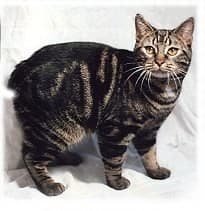
View Manx breedersSee Manx kittens
No breeder is on record here yet. Portugal’s FIFe member club does not list this breed in its breeder directory at all, so an absence here says nothing about whether anyone breeds it in Portugal.
- Typical life span
- 12-14 years
- Size
- Medium — from its typical weight
- Weight
- 3.6-5.9 kg
- Height
- 25-30 cm
- Registry status
- Recognised by TICA
- Breed group
- Short/Long-hair
- Origin
- Isle of Man
- Known hereditary risks
- 1 documented condition, with the test for each
About
What is a Manx?
Medium-sized, compact cat with round body and no tail or partial tail. Powerful hindquarters give rabbit-like hopping gait.
Manx history and origins
Ancient breed from the Isle of Man where taillessness developed through isolated island genetics. Taillessness caused by dominant gene. Various tail lengths occur - rumpy (no tail) to longy (full tail).
Manx appearance and size
Typically 3.6-5.9 kg and 25-30 cm at the shoulder — published as one range rather than separately for males and females.
Manx temperament and personality
Generally described as easy going, intelligent, loyal, playful, social, gentle and affectionate.
That is the breed in general, not a promise about one animal. Ask the breeder what their own line is like, and meet the parents before you decide.
Breed reference from The Cat API.
Characteristics
- Size
- Medium
- Exercise needs
- —
- Easy to train
- —
- Amount of shedding
- 3 of 5
- Grooming needs
- 2 of 5
- Good with children
- —
- Cost to keep
- —
- Tolerates being alone
- —
- Intelligence
- —
- Health of breed
- 1 condition documented
Pros & cons
Pros & cons for the Manx
What you get with the Manx
- Low grooming needs, fitting for a busy owner — the coat is “Double, short and glossy coat”
- Commonly described as: “Easy Going, Intelligent, Loyal, Playful”
What you are taking on
- One serious inherited condition is documented, in bones & joints. The health guide tab has the test to ask a breeder for.
Drawn from sources rather than written as an opinion — cited health research, the registry’s own standard, and peer-reviewed longevity. FIFe breed standard; The Cat API; Vetlexicon Felis — Sacrocaudal dysgenesis of Manx cats. One breeder’s animals can differ from any of it, and an empty column means we hold nothing for that side rather than that there is nothing to say.
Characteristics
FIFe standard · Manx
Coat and colour
As the FIFe standard sets it out. Every line below is the standard’s own wording, tagged permissible.
Coat
Double, short and glossy coat.
The undercoat is softer than the dense and springy overcoat.
Colour
- Preferred
- Permissible
- Undesirable
- Disqualifying
Preferred, permissible, undesirable and disqualifying are FIFe’s own words about the breed. They describe what the standard asks for — not an assessment of any individual dog, and not ours.
Shortened from FIFe standard MAN — each label is the standard’s own wording with the verdict lifted into the tag beside it. Read the full clause at source.
TICA divisions
TICA lists the Manx in these divisions. They are the registry's own groupings — usually hair length — not a list of colours: no registry we hold publishes one. Ask a breeder what colours their line produces.
- Tailed
Temperament
Easy GoingIntelligentLoyalPlayfulSocialGentleAffectionate
Breed-level information from The Cat API. It describes the Manx in general; any individual animal can differ.
Health guide
Health & screening guide for the Manx
Known hereditary risks for the Manx breed, and the specific documentation to request from any breeder before paying a deposit. A responsible breeder will have these readily available; deflection is a red flag.
1 condition documentedThis is breed-level literature, not veterinary advice about an individual animal — your vet knows the animal.
Health checklist (PDF)Bones & joints
Sacrocaudal dysgenesis ("Manx syndrome")
SeriousInherent to the breed
The same dominant gene that shortens or removes the tail can also disrupt development of the lowest spinal segments and the nerves supplying the hind legs, bladder and bowel. Effects range from none at all to hind-limb weakness, a hopping gait and incontinence, and can include spina bifida. Fully tailless cats ("rumpies") carry the highest risk; the more tail present, the lower the risk.
What to ask for
There is no DNA test for the Manx tail-length gene or for Manx syndrome. Ask for a veterinary neurological and orthopaedic exam of both parents (hind-limb function, tail-stump/sacral palpation, continence) and, for any cat showing signs, spinal imaging.
Gallery
No photographs yet
This is where Manx owners’ own photographs will go, from the pet profiles they keep here. Nobody has added one to a public page yet.
A photograph in a pet profile stays private to its owner. We will not put one here unless they ask us to.
Kittens
No kittens listed right now
No Manx breeder has a record on this platform yet, so there is nothing to list. That is a gap in our coverage, not a fact about the breed.