- All colour varieties and patterns are recognised, including those with white.
- Permissible: Any amount of white
About the Devon Rex
Origin: United Kingdom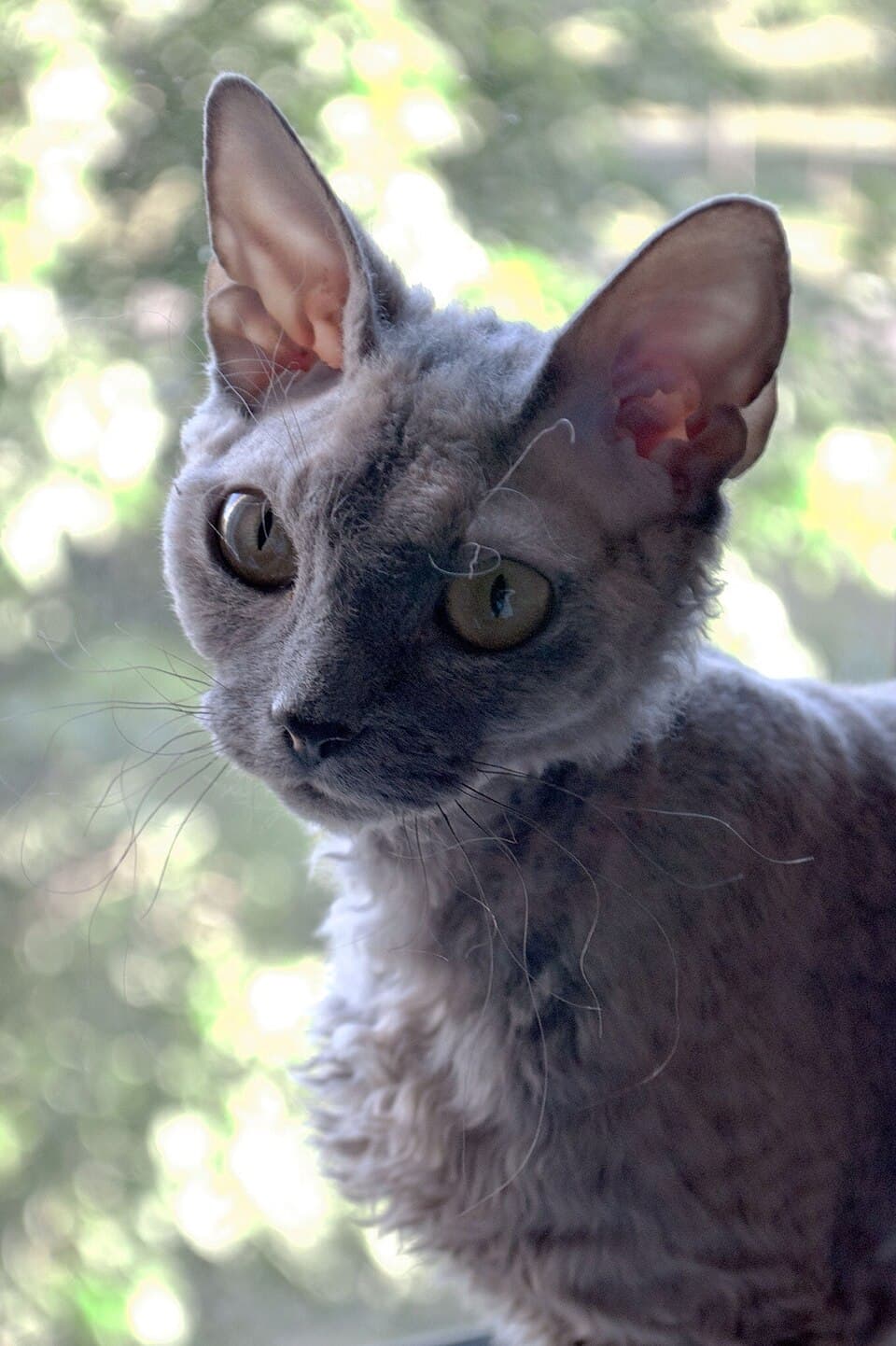
- Typical life span
- 10-15 years
- Size
- Small — from its typical weight
- Weight
- 2.3-4.5 kg
- Height
- 25-30 cm
- Registry status
- Recognised by TICA
- Breed group
- Rex
- Origin
- United Kingdom
- Known hereditary risks
- 4 documented conditions, with the test for each
About
What is a Devon Rex?
Small to medium cat with distinctive wavy coat, large ears, and pixie-like face. Known for its mischievous, dog-like personality.
Devon Rex history and origins
Originated in Devon, England in 1960 from a curly-coated feral cat. Different mutation from Cornish Rex despite similar appearance. Known as the 'pixie cat' for its elfin features.
Devon Rex appearance and size
Typically 2.3-4.5 kg and 25-30 cm at the shoulder — published as one range rather than separately for males and females.
Devon Rex temperament and personality
Generally described as highly interactive, mischievous, loyal, social, playful and affectionate.
That is the breed in general, not a promise about one animal. Ask the breeder what their own line is like, and meet the parents before you decide.
Breed reference from The Cat API.
Characteristics
- Size
- Small
- Exercise needs
- —
- Easy to train
- —
- Amount of shedding
- —
- Grooming needs
- 4 of 5
- Good with children
- —
- Cost to keep
- —
- Tolerates being alone
- —
- Intelligence
- —
- Health of breed
- 4 conditions documented
Pros & cons
Pros & cons for the Devon Rex
What you get with the Devon Rex
- Commonly described as: “Highly interactive, Mischievous, Loyal, Social”
What you are taking on
- 2 serious inherited conditions are documented, mainly in brain & nerves and kidneys & urinary. The health guide tab has the test to ask for on each.
- High grooming needs — the standard’s own description is “soft, wavy and/or curly, with or without guard hairs.”
Drawn from sources rather than written as an opinion — cited health research, the registry’s own standard, and peer-reviewed longevity. The Cat API; UC Davis Veterinary Genetics Laboratory; FIFe breed standard. One breeder’s animals can differ from any of it, and an empty column means we hold nothing for that side rather than that there is nothing to say.
Characteristics
FIFe standard · Devon Rex
Coat and colour
As the FIFe standard sets it out. Every line below is the standard’s own wording, tagged permissible.
Coat
Very short and fine
soft, wavy and/or curly, with or without guard hairs.
Bare patches are permitted only in cats up to 12 months.
Colour
- Preferred
- Permissible
- Undesirable
- Disqualifying
Preferred, permissible, undesirable and disqualifying are FIFe’s own words about the breed. They describe what the standard asks for — not an assessment of any individual dog, and not ours.
Shortened from FIFe standard DRX — each label is the standard’s own wording with the verdict lifted into the tag beside it. Read the full clause at source.
Temperament
InteractiveMischievousLoyalSocialPlayfulAffectionate
Breed-level information from The Cat API. It describes the Devon Rex in general; any individual animal can differ.
Health guide
Health & screening guide for the Devon Rex
Known hereditary risks for the Devon Rex breed, and the specific documentation to request from any breeder before paying a deposit. A responsible breeder will have these readily available; deflection is a red flag.
4 conditions documentedThis is breed-level literature, not veterinary advice about an individual animal — your vet knows the animal.
Health checklist (PDF)Brain & nerves
Congenital myasthenic syndrome (CMS)
Serious
A mutation in COLQ disrupts signalling at the neuromuscular junction, causing muscle weakness, exercise intolerance and, in some cats, regurgitation with risk of aspiration pneumonia. Signs typically appear in kittens.
What to ask for
COLQ DNA test, UC Davis VGL, explicitly validated for Devon Rex (and Sphynx).
Hormones & metabolism
Hypokalaemia
Monitor
Devon Rex is named on the WNK4 hypokalaemia test's VGL breed list. The mutation causes episodic muscle weakness from low blood potassium.
What to ask for
WNK4 DNA test, UC Davis VGL, explicitly validated for Devon Rex. Usually managed with oral potassium supplementation once identified.
Kidneys & urinary
Polycystic kidney disease (PKD1)
Serious
Devon Rex is named on VGL's PKD1 breed list. An autosomal dominant mutation causes fluid-filled kidney cysts that enlarge over time and can progress to kidney failure.
What to ask for
PKD1 DNA test, UC Davis VGL, explicitly validated for Devon Rex.
Blood
Neonatal isoerythrolysis risk (blood type B)
Monitor
Devon Rex is named by UC Davis VGL as one of the breeds with a high frequency of the blood type B allele. A type B queen mated to a type A or AB tom risks kittens developing neonatal isoerythrolysis after nursing colostrum containing anti-A antibodies.
What to ask for
AB blood typing test (UC Davis VGL and other labs). Both breeding partners should be blood-typed before pairing.
Gallery
No photographs yet
This is where Devon Rex owners’ own photographs will go, from the pet profiles they keep here. Nobody has added one to a public page yet.
A photograph in a pet profile stays private to its owner. We will not put one here unless they ask us to.
Kittens
No kittens listed right now
That is not the same as none existing. Publishing a litter is part of a breeder's subscription here, so a Devon Rex breeder can have a litter and no listing — ask them directly.
See Devon Rex breeders