
- Permissible: All shades of blue, ranging from pale blue-grey to a deeper blue-grey, pale blue-grey is
- Uniformity in tone is essential.
About the Chartreux
Origin: France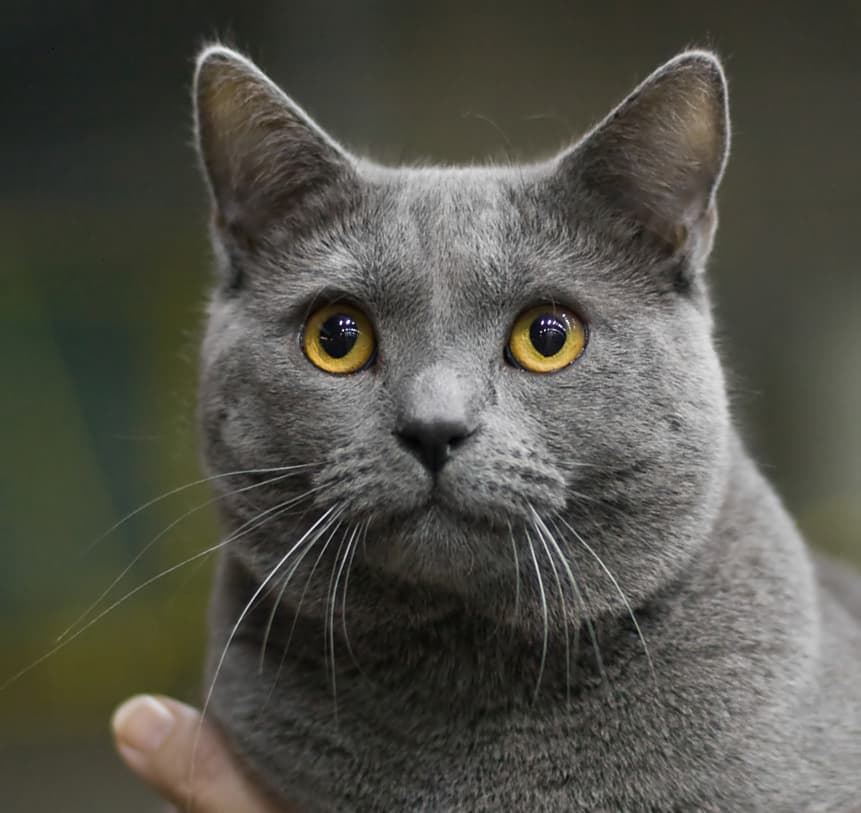
- Typical life span
- 12-15 years
- Size
- Large — from its typical weight
- Weight
- 5.4-7.3 kg
- Height
- 28-36 cm
- Registry status
- Recognised by TICA
- Breed group
- Short-haired
- Origin
- France
- Known hereditary risks
- None well documented
About
What is a Chartreux?
Medium to large, muscular cat with distinctive blue-gray woolly coat and copper or orange eyes. Known for its quiet, observant nature and sweet smile.
Chartreux history and origins
Ancient French breed possibly dating to medieval times. Legend says they were bred by Carthusian monks. Nearly extinct after WWII but carefully rebuilt. National cat of France.
Chartreux appearance and size
Typically 5.4-7.3 kg and 28-36 cm at the shoulder — published as one range rather than separately for males and females.
Chartreux temperament and personality
Generally described as affectionate, loyal, intelligent, social, lively, playful, calm and observant.
That is the breed in general, not a promise about one animal. Ask the breeder what their own line is like, and meet the parents before you decide.
Breed reference from The Cat API.
Characteristics
- Size
- Large
- Exercise needs
- —
- Easy to train
- —
- Amount of shedding
- 4 of 5
- Grooming needs
- —
- Good with children
- —
- Cost to keep
- —
- Tolerates being alone
- —
- Intelligence
- —
- Health of breed
- Nothing hereditary documented
Pros & cons
Pros & cons for the Chartreux
What you get with the Chartreux
- Commonly described as: “Affectionate, Loyal, Intelligent, Social”
What you are taking on
Nobody has written this side yet. It is a judgement rather than data, so it waits for a person — not for a missing source.
Drawn from sources rather than written as an opinion — cited health research, the registry’s own standard, and peer-reviewed longevity. The Cat API. One breeder’s animals can differ from any of it, and an empty column means we hold nothing for that side rather than that there is nothing to say.
Characteristics
FIFe standard · Chartreux
Coat and colour
As the FIFe standard sets it out. Every line below is the standard’s own wording, tagged permissible.
Coat
Glossy, dense
slightly woolly at the base, luxurious in growth.
Double coat, making the hair stand out.
Colour
- Preferred
- Permissible
- Undesirable
- Disqualifying
Preferred, permissible, undesirable and disqualifying are FIFe’s own words about the breed. They describe what the standard asks for — not an assessment of any individual dog, and not ours.
Shortened from FIFe standard CHA — each label is the standard’s own wording with the verdict lifted into the tag beside it. Read the full clause at source.
Temperament
AffectionateLoyalIntelligentSocialLivelyPlayfulCalmObservant
Breed-level information from The Cat API. It describes the Chartreux in general; any individual animal can differ.
Health guide
Health & screening guide for the Chartreux
Nothing hereditary is documented for the Chartreux breed, but there is still specific documentation to request from any breeder before paying a deposit. A responsible breeder will have these readily available; deflection is a red flag.
No breed-specific hereditary condition for Chartreux could be confirmed against UC Davis VGL, OMIA, TICA or icatcare. Patellar luxation and hip dysplasia are sometimes claimed for the breed online, but every instance found traces to pet-insurance marketing pages or templated veterinary-clinic 'breed info' pages carrying identical wording across unrelated clinic websites -- not an authoritative source, so the claim is not repeated here. A multi-breed Czech prevalence study that might bear on orthopaedic conditions across several breeds, including Chartreux, could not be retrieved (access was blocked) and is an open gap rather than a resolved finding.
What to ask for anyway
- Cardiac auscultation (and echocardiogram if a murmur or arrhythmia is heard), as for any breeding cat, since hypertrophic cardiomyopathy occurs across the species and is not breed-limited to breeds with a known mutation
- A general veterinary health check of the parents with no unexplained health complaints in the line
- Routine infectious disease and parasite screening consistent with responsible breeding practice generally
0 sources
Gallery
No photographs yet
This is where Chartreux owners’ own photographs will go, from the pet profiles they keep here. Nobody has added one to a public page yet.
A photograph in a pet profile stays private to its owner. We will not put one here unless they ask us to.
Kittens
No kittens listed right now
That is not the same as none existing. Publishing a litter is part of a breeder's subscription here, so a Chartreux breeder can have a litter and no listing — ask them directly.
See Chartreux breeders