
- Silver grey to grey black specled forming a bluish shade, with or without black patches.
- (“mixed black and white and/or black and white speckling” resulting in an overall silver-grey black coat according to the traditional classification system)
About the Blue Picardy Spaniel
Origin: France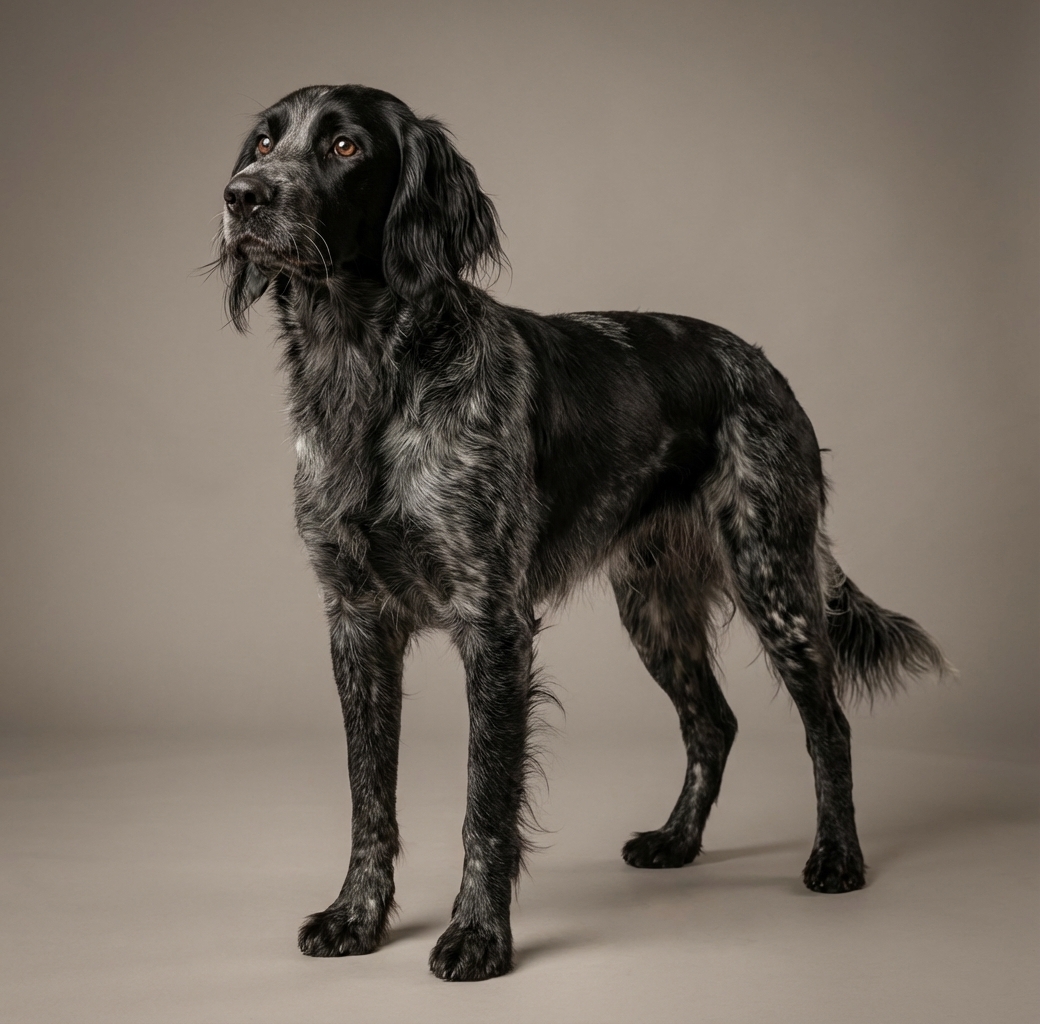
- Typical life span
- 10-14 years
- Size
- Medium — from its typical weight
- Weight
- 19.5-22.7 kg
- Height
- Male
- 57-61 cm
- Female
- 55-60 cm
- FCI status
- Recognised by FCI
- FCI group
- Pointing Dogs
- Origin
- France
- Also called
- Spaniel Azul de Picardia
- Known hereditary risks
- Not researched yet
About
What is a Blue Picardy Spaniel?
Medium-sized, strongly built gundog with distinctive blue-gray roan speckled coat that gives it a bluish appearance. Known for its gentle hunting temperament and versatile field abilities.
Blue Picardy Spaniel history and origins
Developed in the Picardy region of France in the early 20th century by crossing Picardy Spaniels with English Setters (likely Gordon Setters) to produce a versatile, hardy pointing dog with the distinctive blue-speckled coat. Recognized by the FCI.
Blue Picardy Spaniel appearance and size
Males typically stand 57-61 cm at the shoulder and females 55-60 cm.
What the breed standard says
- Bred for
- Pointing dog
- Behaviour and temperament
“Flexible and gentle dog with an even temperament, well adapted to family life; should come out as placid and never aggressive. An athletic dog, the Blue Picardy Spaniel enjoys a daily walk to work off his energy”
Quoted from FCI standard n°106. It describes the breed the registry recognises, not any individual animal.
Breed reference from The Dog API.
Characteristics
- Size
- Medium
- Exercise needsRead from what the breed was bred to do, in the registry’s own words: “Pointing dog” That is a working purpose, not a measured exercise requirement — an individual dog’s needs depend on its age, health and household.
- 4 of 5
- Easy to train
- —
- Amount of shedding
- —
- Grooming needs
- 4 of 5
- Good with children
- —
- Cost to keep
- —
- Tolerates being alone
- —
- Intelligence
- —
- Health of breed
- Not researched yet
Pros & cons
Pros & cons for the Blue Picardy Spaniel
What you get with the Blue Picardy Spaniel
- Purpose stated in the standard: “Pointing dog”
- The standard describes the breed as: “Flexible and gentle dog with an even temperament, well adapted to family life”
What you are taking on
- High grooming needs — the standard’s own description is “Legs and tail well furnished with fringes”
Drawn from sources rather than written as an opinion — cited health research, the registry’s own standard, and peer-reviewed longevity. FCI breed standard. One breeder’s animals can differ from any of it, and an empty column means we hold nothing for that side rather than that there is nothing to say.
Characteristics
FCI standard · Blue Picardy Spaniel
Coat and colour
As the FCI standard sets it out. Every line below is the standard’s own wording.
Coat
Flat or slightly wavy.
Legs and tail well furnished with fringes
Colour
- Preferred
- Permissible
- Undesirable
- Disqualifying
Preferred, permissible, undesirable and disqualifying are FCI’s own words about the breed. They describe what the standard asks for — not an assessment of any individual dog, and not ours.
Shortened from FCI standard n°106 — each label is the standard’s own wording with the verdict lifted into the tag beside it. Read the full clause at source.
What the breed standard says
- Size
- “Height at the withers: 57 to 62 cm for the males 55 to 60 cm for the females. A tolerance of ± 2 cm is permitted yet undesirable”
- FCI states a tolerance around the figure.
Quoted from FCI standard n°106. It describes the breed the registry recognises, not any individual animal.
What the standard penalises
What a judge marks the Blue Picardy Spaniel down for, and what puts one out of the ring, in the registry’s own words. This describes the breed standard — it is not a checklist for the animal in front of you, and a pet with a disqualifying fault is an unshowable dog rather than an unhealthy one.
Severe faults
Marked heavily against a specimen in the ring.
- Skull: too broad or too narrow.
- Ear: too short or triangular.
- Nose: any colour other than black; lack of pigmentation (nose largely flesh-coloured).
- Eye: Light and too small.
- Lack of bone
Disqualifying faults
Puts an animal out of the ring altogether.
- Overshot or undershot bite.
- Teeth: one missing canine or 2 missing incisors or more than 2 other missing teeth (PM or M) with the exception of PM1 and M3.
- Size outside the limits of tolerance of the standard.
- Lack of type.
- Atypical coat (white or brown patches)
Breed-level information from The Dog API. It describes the Blue Picardy Spaniel in general; any individual animal can differ.
Health guide
What to ask for in a Blue Picardy Spaniel
No breed-specific health panel has been written up for the Blue Picardy Spaniel on this platform yet. That is a gap in our records, not a clean bill of health — ask the breeder which hereditary conditions their lines are tested for, and ask to see the results for both parents, dated and from a named laboratory.
Gallery
No photographs yet
This is where Blue Picardy Spaniel owners’ own photographs will go, from the pet profiles they keep here. Nobody has added one to a public page yet.
A photograph in a pet profile stays private to its owner. We will not put one here unless they ask us to.
Puppies
No puppies listed right now
No Blue Picardy Spaniel breeder has a record on this platform yet, so there is nothing to list. That is a gap in our coverage, not a fact about the breed.