
- the bicolours black and tan and liver and tan and the unicolour red.
- Among black and tan dogs, the amount of black varies, according to whether it is a mantle or a saddle.
- In a dog with a mantle, black is predominant: the tan (fawn) is only found on the muzzle, the cheeks, above the eyes, on the forechest, on the limbs and the anal region.
- A dog with a saddle has a greater expanse of tan because the black is more or less limited to the dorsal region.
- The same positioning of coloured zones is to be found in the bicoloured liver and tan.
- The colours are not always clearly stated nor distinctly defined.
- In the darker areas, it is possible to find them interspersed with lighter or badger hairs.
- Permissible: Such a mixture of different coloured hairs
- For the unicoloured red, the red can vary from light red to dark red.
- A washed-out tan for bicolours or red for unicolours is not sought after.
- Permissible: A little white on the forechest, on the toes and at the tip of the tail without being sought after
About the Bloodhound
Origin: Belgium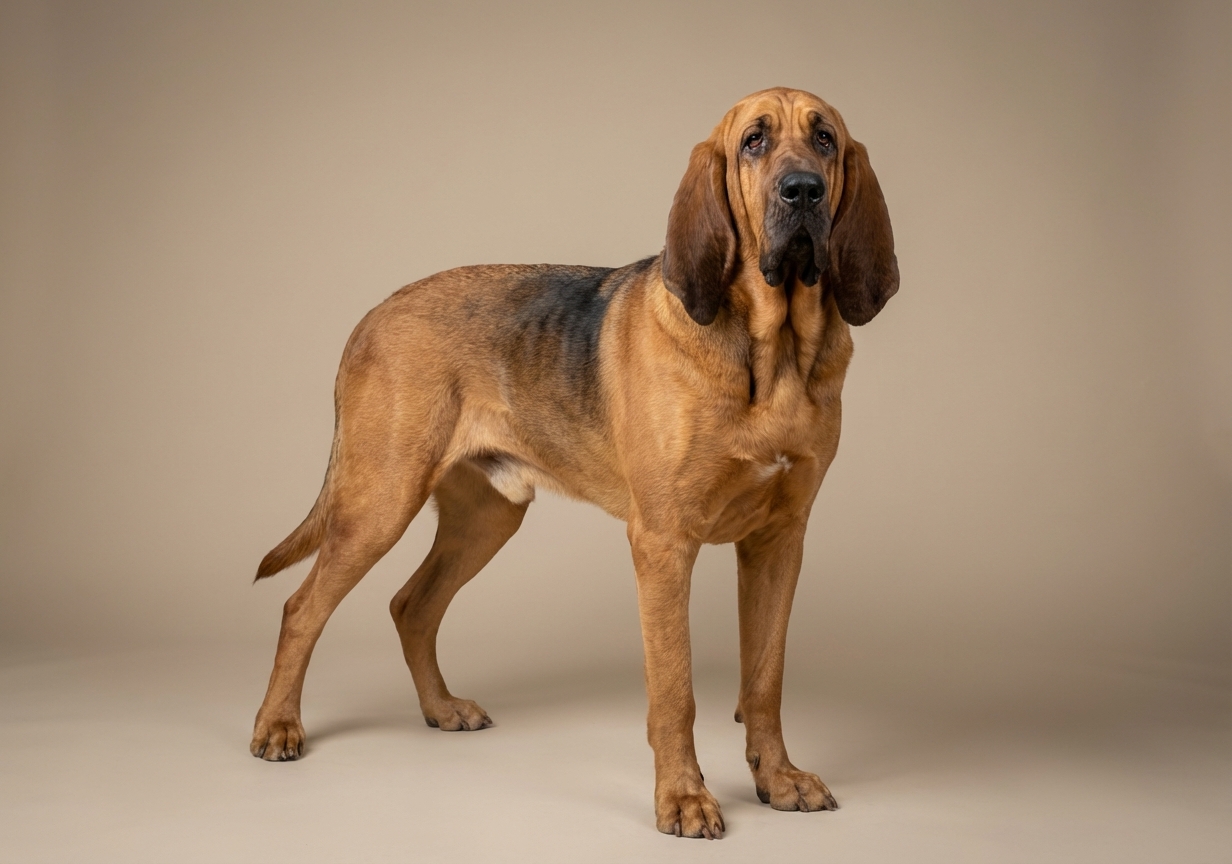
- Typical life span
- 10-12 years
- Size
- Large — from its typical weight
- Weight
- Male
- 41-50 kg
- Female
- 36-45 kg
- Height
- Male
- 64-69 cm
- Female
- 58-64 cm
- FCI status
- Recognised by FCI
- FCI group
- Scent hounds and related breeds
- Origin
- Belgium
- Also called
- Chien de Saint Hubert
- Known hereditary risks
- Not researched yet
About
What is a Bloodhound?
Large, substantial scent hound with a noble, dignified expression, characterized by exceptional tracking ability, distinctive wrinkled face, long drooping ears, loose skin, and pendulous jowls. Renowned for its extraordinary sense of smell and unparalleled tracking abilities.
Bloodhound history and origins
Ancient breed developed by monks at the Abbey of Saint-Hubert in Belgium and France during medieval times. Later refined in England and valued for centuries for tracking game and people, eventually imported to the US for search and rescue work.
Bloodhound appearance and size
Males typically weigh 41-50 kg and stand 64-69 cm at the shoulder; females 36-45 kg and 58-64 cm.
What the breed standard says
- Bred for
- Scent hound for large game venery, service dog, tracking dog and family dog. It was and it must always remain a hound which due to its remarkable sense of smell is foremost a leash hound, often used not only to follow the trail of wounded game as in the blood scenting trials but also to seek out missing people in police operations. Due to its functional construction, the Bloodhound is endowed with great endurance and also an exceptional nose which allows it to follow a trail over a long distance and difficult terrain without problems
- Behaviour and temperament
“Gentle, placid, kind and sociable with people. Particularly attached to its owner. Tolerant of kennel companions and other domestic animals. Somewhat reserved and stubborn. Just as sensitive to compliments as to corrections. Never aggressive. Its voice is deep but it rarely barks”
Quoted from FCI standard n°84. It describes the breed the registry recognises, not any individual animal.
Breed reference from The Dog API.
Characteristics
- Size
- Large
- Exercise needs
- —
- Easy to train
- —
- Amount of shedding
- —
- Grooming needs
- 3 of 5
- Good with children
- —
- Cost to keep
- —
- Tolerates being alone
- —
- Intelligence
- —
- Health of breed
- Not researched yet
Pros & cons
Pros & cons for the Bloodhound
What you get with the Bloodhound
- Purpose stated in the standard: “Scent hound for large game venery, service dog, tracking dog and family dog”
- The standard describes the breed as: “Gentle, placid, kind and sociable with people”
What you are taking on
- Shorter-lived than a crossbred dog — median 9.3 years across 144 animals, against 12
Drawn from sources rather than written as an opinion — cited health research, the registry’s own standard, and peer-reviewed longevity. FCI breed standard; McMillan et al. 2024, median age at death. One breeder’s animals can differ from any of it, and an empty column means we hold nothing for that side rather than that there is nothing to say.
Characteristics
FCI standard · Bloodhound
Coat and colour
As the FCI standard sets it out. Every line below is the standard’s own wording, tagged permissible.
Coat
On the body, the close-lying hair is short, dense, quite harsh and weatherproof.
On the head and ears the hair is very short and soft to the touch.
The underside of the tail is furnished with hair a little longer and coarser
Colour
- Preferred
- Permissible
- Undesirable
- Disqualifying
Preferred, permissible, undesirable and disqualifying are FCI’s own words about the breed. They describe what the standard asks for — not an assessment of any individual dog, and not ours.
Shortened from FCI standard n°84 — each label is the standard’s own wording with the verdict lifted into the tag beside it. Read the full clause at source.
What the breed standard says
- Size
- “Height at withers: The ideal height is 68 cm for males. Tolerance of 4 cm more or less. 62 cm for females. Weight: Males about 46 - 54 kg. Females about 40 – 48 kg. Height and weight must be balanced”
- FCI states a tolerance around the figure.
Quoted from FCI standard n°84. It describes the breed the registry recognises, not any individual animal.
What the standard penalises
What a judge marks the Bloodhound down for, and what puts one out of the ring, in the registry’s own words. This describes the breed standard — it is not a checklist for the animal in front of you, and a pet with a disqualifying fault is an unshowable dog rather than an unhealthy one.
Disqualifying faults
Puts an animal out of the ring altogether.
- General appearance: Lack of breed type.
- Dentition: Over or under shot; wry jaw; crooked mouth.
- Nose and lips: Very lacking in pigment or pink; anything other than black in black and tan dogs; anything other than brown or black in dogs without black saddle or mantle.
- Eyes: Light yellow (hawk eyes).
- Coat colour : Any colours which do not correspond to those described ; too widespread white markings, such as white going up as far as wrists or hocks, or too much white on the forechest ; white patches anywhere other than the forechest, toes and tip of tail, like a white muzzle or a white blaze etc.
- Size: Outside the tolerated limits
Breed-level information from The Dog API. It describes the Bloodhound in general; any individual animal can differ.
Health guide
What to ask for in a Bloodhound
No breed-specific health panel has been written up for the Bloodhound on this platform yet. That is a gap in our records, not a clean bill of health — ask the breeder which hereditary conditions their lines are tested for, and ask to see the results for both parents, dated and from a named laboratory.
Gallery
No photographs yet
This is where Bloodhound owners’ own photographs will go, from the pet profiles they keep here. Nobody has added one to a public page yet.
A photograph in a pet profile stays private to its owner. We will not put one here unless they ask us to.
Puppies
No puppies listed right now
No Bloodhound breeder has a record on this platform yet, so there is nothing to list. That is a gap in our coverage, not a fact about the breed.