
- Black, black and tan, red, red and tan, fawn, chocolate, and smoke blue
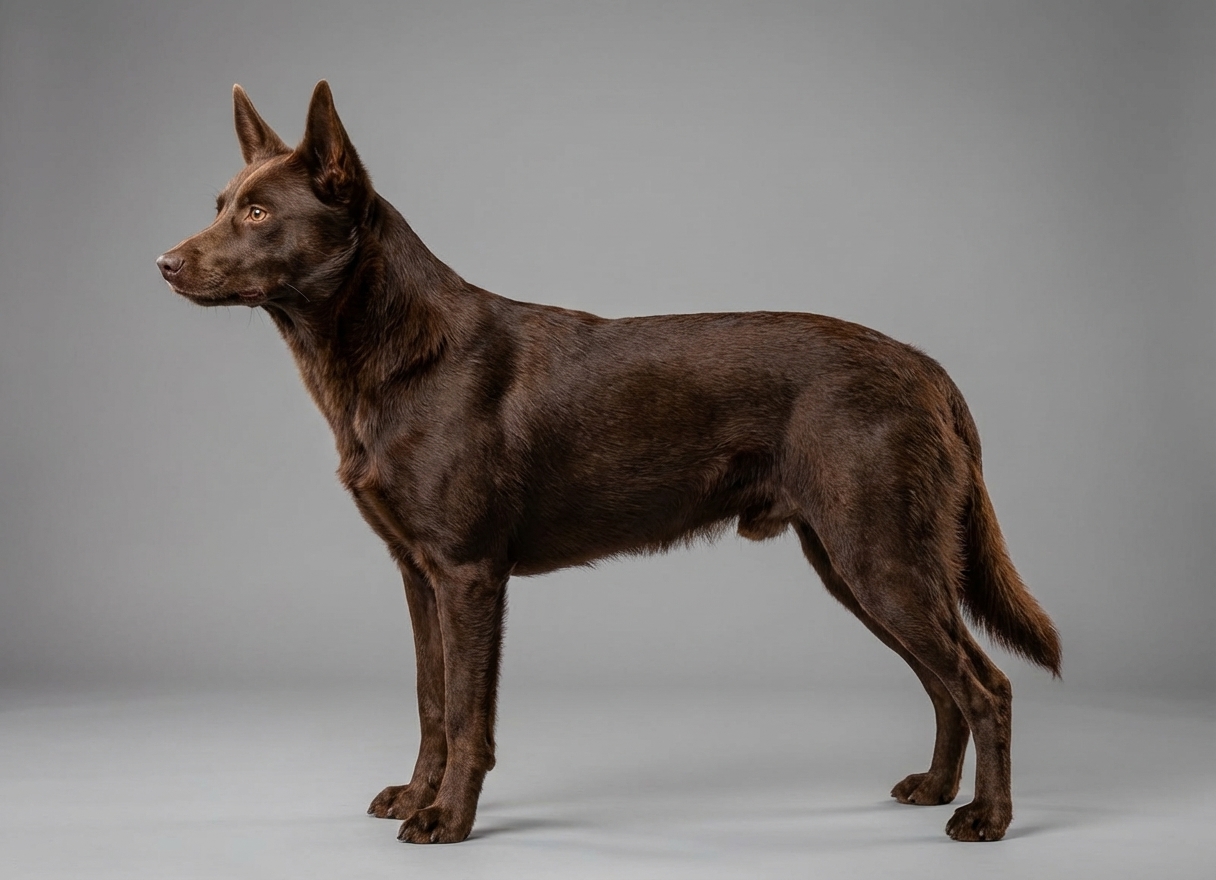
Medium-sized athletic herding dog with exceptional energy and intelligence, developed for working sheep over vast distances in harsh Australian conditions. Known for their lithe, agile build and inexhaustible work ethic.
Developed in Australia during the late 19th century from crosses of imported Scottish Collies with Dingoes and other working dogs to create the ultimate sheep herding dog capable of working independently over vast distances in harsh climates
“The Kelpie is extremely alert, eager and highly intelligent, with a mild, tractable disposition and an almost inexhaustible energy, with marked loyalty and devotion to duty. It has a natural instinct and aptitude in working of sheep, both in open country and in the yard. Any defect of structure or temperament foreign to a working dog must be regarded as uncharacteristic”
Quoted from FCI standard n°293. It describes the breed the registry recognises, not any individual animal.
Breed reference from The Dog API.
Drawn from sources, not opinion: FCI breed standard; O'Brien et al. 2020, Scientific Reports. An empty column means we hold nothing for that side, not that there is nothing to say.
What a judge marks the Australian Kelpie down for, and what puts one out of the ring, in the registry’s own words. This describes the breed standard — it is not a checklist for the animal in front of you, and a pet with a disqualifying fault is an unshowable dog rather than an unhealthy one.
Marked heavily against a specimen in the ring.
The Australian Kelpie standard is published by the FCI (Fédération Cynologique Internationale), the international federation of pedigree-dog clubs, and it is what show judges apply. This section sums up what it says about coat and colour and size. It does not assess any one animal: use it to know what to ask the breeder.
The coat is a double coat with a short dense undercoat.
The outer coat is close, each hair straight, hard and lying flat, so that it is rain-resisting.
Under the body, to behind the legs, the coat is longer and forms near the thigh a mild form of breeching.
On the head (including the inside of the ears), to the front of the legs and feet, the hair is short.
Along the neck it is longer and thicker forming a ruff.
The tail should be furnished with a good brush.
As an average, the hairs on the body should be from 2 to 3 cms in length
Notes
Shortened from FCI standard n°293 — each label is the standard’s own wording with the verdict lifted into the tag beside it. Read the full clause at source.
The colours and patterns the standard admits, and what it prefers, discourages or disqualifies in each. An accepted colour says nothing about health.
Height at the withers (cm)
The same scale for every breed: no source defines size categories by height.
The standard's words
“Height at the withers: Males: 46 to 51 cms. Females: 43 to 48 cms”
Quoted from FCI standard n°293.
An adult's measurements, per the standard. It does not say how big this puppy will be. Quotations from the FCI are in English, as the standard publishes them; the headings are ours.
Breed-level information from The Dog API. It describes the Australian Kelpie in general; any individual animal can differ.
Known hereditary risks for the Australian Kelpie breed, and the specific documentation to request from any breeder before paying a deposit. A responsible breeder will have these readily available; deflection is a red flag.
1 condition documentedThis is breed-level literature, not veterinary advice about an individual animal — your vet knows the animal.
Health checklist (PDF)Documented in this breed, but no source says how many of its dogs carry or have them. That is a gap in the evidence, not a sign they are rare.
An inherited inability to absorb fat from the gut, first described in this breed: affected puppies grow poorly and stay small, with fatty diarrhoea, a swollen belly and a wiry coat. It is recessive — every dog with two copies in the study was affected, and carriers look entirely healthy — so two healthy parents can produce an affected litter.
What to ask for
Intestinal lipid malabsorption (ACSL5 deletion) DNA test result, on both parents
Median survival 12.0 years
95% confidence interval 11.6–13.5 years, from 49 recorded deaths among 107 dogs
Mortality hazard 0.97 (0.74, 1.29) relative to crossbred dogs, whose median is 12.0 years.
Few deaths recorded for this breed, so the figure is imprecise.
Measured in the United Kingdom from 584,734 dogs. Median survival is not a prediction for an individual dog.
McMillan, K.M., Bielby, J., Williams, C.L., Upjohn, M.M., Casey, R.A. & Christley, R.M. (2024) Longevity of companion dog breeds: those at risk from early death. Scientific Reports 14, 531.